2026
The Creative Curriculum® for Pre-K

Pre-Kindergarten - Gateway 2

Back to Pre-Kindergarten Overview
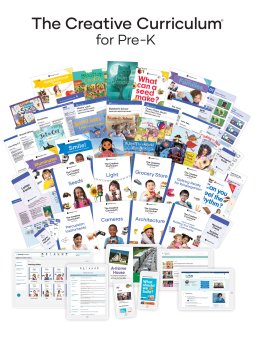
Cover for The Creative Curriculum® for Pre-K
Note on review tool versions

See the series overview page to confirm the review tool version used to create this report.

Loading navigation...

Gateway Ratings Summary

Does the curriculum have high-quality, developmentally appropriate content?

Gateway 2 - Partially Meets Expectations
0%
Criterion 2.1: Curriculum Approach and Design
0 / 12
Criterion 2.2: Social and Emotional Development
0 / 8
Criterion 2.3: Language and Literacy
0 / 12
Criterion 2.4: Mathematics
0 / 12
Criterion 2.5: Science and Engineering
0 / 4
Criterion 2.6: Social Studies
0 / 4
Criterion 2.7: Fine Arts
0 / 4
Criterion 2.8: Physical & Motor Development
0 / 4
Criterion 2.9: Cognitive Processes & Approaches to Learning
0 / 6

Criterion 2.1: Curriculum Approach and Design

0 / 12

Curriculum materials have a coherent and strategic design and approach.

Indicator 2.1a

1 / 2

Social and Emotional Development: Curriculum materials support social-emotional learning through a comprehensive approach that includes clear, developmentally-appropriate learning goals, a well-structured developmental sequence, and research-supported instructional practices.

The Creative Curriculum for Pre-K materials partially meet expectations for supporting social-emotional learning (2.1a).

Foundation Volume 3: Social-Emotional, Physical and Cognitive Development describes how and why an intentional focus on promoting children’s social–emotional development (as well as physical development and cognitive development) is an essential aspect of every day in an early childhood classroom. The first three chapters explain the three components of social–emotional development (positive relationships, emotional awareness and response, and social engagement) and how those components can be observed and nurtured in early childhood classrooms. In these chapters, teachers find guidance for supporting children's social and emotional development while they work and learn in the classroom’s interest areas and throughout different times of the day. The chapters also highlight relevant research on the importance of promoting social and emotional development in young children and the vital role that teachers and caregivers play in helping children grow as individuals and as positive, productive members of a community.

The materials provide clear, developmentally appropriate Social and Emotional learning goals and objectives for Development & Learning. Three out of 38 research-based objectives focus on Social-Emotional:

Objective 1. Regulates own emotions and behaviors

  1. Manages Feelings

  2. Follows limits and expectations

  3. Takes care of own needs appropriately

Objective 2. Establishes and sustains positive relationships

  1. Forms relationships with adults

  2. Responds to emotional cues

  3. Interacts with peers

  4. Makes friends

Objective 3. Participates cooperatively and constructively in group situations

  1. Balances needs and rights of self and others

  2. Solves social problems

These objectives include detailed, color-coded teaching sequences that capture widely held expectations, indicators, and strategies for each objective.  Some social and emotional instructional resources appear in Intentional Teaching Experiences (ITEs) such as:

  • Calm-Down Place (SE03), which introduces a classroom space where children can take a break when they are feeling upset.

  • Talk About Feelings (SEO6), which provides clear steps, materials, teacher language, and guidance aligned with goals such as sustaining relationships and identifying emotions.

  • My Turn at the Microphone (SE10), where children practice initiating and engaging in conversations.

Some social and emotional instructional resources appear in the Teaching Guides:

  • First Six Weeks- (pg.26) There is a focus question dedicated to feelings: “How can we express our feelings at school?” In the Reflection, teachers are prompted to model emotional language (“I’m feeling happy…”) and use “I statements,” with connection to review Intentional Teaching Experience SE16, “I Statements” (pg. 27).

  • Example from The First Six Weeks (SEL ITEs embedded in the daily flow): An At-a-Glance plan lists SEL ITEs directly in the daily resources (e.g., SE21 “Sunshine Message Board,” SE08 “Group Problem-Solving,” SE14 “Playing Together”) alongside Mighty Minutes and other resources (The First Six Weeks, p. 115). 

  • Seeds Teaching Guide includes  “Playful Observations.”

 – Manages feelings (1a) includes guidance to support calming and emotional expression during real interactions (pg. 55).

 – Suggests solutions to social problems (3b) prompts teachers to notice and support how children resolve peer issues and provides concrete ways to scaffold problem-solving (pg. 66).

Additional social and emotional resources are found in some of the  Mighty Minute Activities (transition cards) that address Social and Emotional Objectives:

  •  The Feelings In Your Face (MM143) aligned with Objective 2b, “Responds to emotional cues.”

  • Welcome, Everyone, (MM201) activity  which promotes skills related to Objective 3a, “Balances the needs and rights of self and others.” 

  • Sunshine & Rain Cloud (MM227 activity, which describes a short activity to promote skills related to Objective 2b, “Responds to emotional cues.”

The materials include research-based objectives and high-quality activities. SEL objectives are most often referenced within ITEs and supporting resources rather than systematically integrated into daily lesson plans. Additionally, the limited number of SEL-focused ITEs (36) and the flexible implementation structure require teachers to determine when and how these experiences occur. Although the Objectives for Development & Learning describe developmental progressions, the materials do not consistently show how those progressions are implemented across daily instruction. The color-coded Teaching Sequences describe scaffolding within individual activities rather than progression across lessons or the year. While the curriculum includes strong foundations for supporting social-emotional development, the materials do not consistently make the developmental sequence visible within the daily instructional framework. As a result, teachers must make individual decisions about when and how to address SEL, leading to inconsistent implementation across classrooms.

Overall, The Creative Curriculum for Pre-K provides a strong foundation for supporting social-emotional development through research-based objectives, guidance in the Foundation volumes, and instructional resources. However, SEL objectives and supports are not consistently embedded within the daily instructional framework in a clear way that demonstrates how skills build over time.

Indicator 2.1b

1 / 2

Language and Literacy: Curriculum materials support language and literacy instruction through a comprehensive approach that includes clear, developmentally-appropriate learning goals, a well-structured scope and sequence, and research-supported instructional practices.

The Creative Curriculum for Pre-K materials partially meet expectations for supporting language and literacy instruction (2.1b). 

Foundation Volume 4, Language & Literacy, provides educators with instructional content on the components of language development and literacy learning, as well as research-based information on planning an effective literacy program that intentionally supports relevant objectives.  Specific strategies and information are provided on the components of literacy, including:

  • vocabulary and language

  • phonological awareness

  • knowledge of print

  • letters and words

  • comprehension

  • books and other texts

  • literacy as a source of enjoyment

There are several objectives that address language and literacy. Objectives 8, 9, and 10 relate to children’s language development, and Objectives 15–19 relate to literacy learning. Objectives 37 and 38 relate to multilingual learners’ English language acquisition.

Objective 8. Listens to and understands increasingly complex language

  1. Comprehends language

  2. Follows directions

Objective 9. Uses language to express thoughts and needs 

  1. Uses an expanding expressive vocabulary

  2. Speaks clearly

  3. Uses conventional grammar

  4. Tells about another time and place

Objective 10. Uses appropriate conversational and other communication skills 

  1. Engages in conversation

  2. Uses social rules of language

Objective 15. Demonstrates phonological awareness, phonics skills, and word recognition

. a. Notices and discriminates rhyme

b. Notices and discriminates alliteration

c. Notices and discriminates discrete units of sound

d. Applies phonics concepts and knowledge of word structure to decode text

Objective 16. Demonstrates knowledge of the alphabet 

  1. Identifies and names letters

  2. Uses letter–sound correspondences

Objective 17. Demonstrates knowledge of print and the uses 

  1. Uses and appreciates books and other texts

  2. Uses print concepts

Objective 18. Comprehends and responds to books and other texts 

  1. Interacts during reading experiences, book conversations, and text reflections

  2. Uses emergent reading skills

  3. Retells stories and recounts details from informational texts

  4. Uses context clues to read and comprehend texts

  5. Reads texts fluently

Objective 19. Demonstrates writing skills 

  1. Writes name

  2. Writes conveying ideas and information

  3. Writes using conventions

Objective 37. Demonstrates progress in listening to and understanding English 

Objective 38. Demonstrates progress in speaking English

The materials offer some opportunities for children to explore language and literacy. Children engage with print, letters, rhymes, new vocabulary, and emergent writing through read-alouds, small groups, interest areas, and daily routines (Volume 3: Literacy, pp. 20–22, 30–35, 44–47, 72–75, 110–115). Intentional Teaching Experiences Cards, such as LL08, LL33, LL43, LL55, and LL61, show how teachers can connect literacy to science, storytelling, and creative play.  Other resources, such as the Message Board and Dramatic Play Area, provide authentic opportunities to practice language in social and problem-solving contexts (Volume 2: Interest Areas, pp. 85, 92–100). 

Additional resources supporting language and literacy instruction include:

•  Cameras Teaching Guide-  Question of the Day targeting phonological awareness (“What is a word that rhymes with cat?”), plus alphabet knowledge (“What letter does your name start with?”) (Cameras Teaching Guide, p. 52). The same plan embeds literacy in Read-Aloud/Playing With Pre-Reading Skills using Mighty Minutes 234 “Perfect Pairs” (letter matching) and Mighty Minutes 266 “Letter Sounds” (letter–sound work) (Cameras Teaching Guide, p. 52) and includes Focused Language & Literacy via ITE LL17 “Walk a Letter” (Cameras Teaching Guide, p. 52).

•   Light Teaching Guide- embeds skill practice within a study context. One daily plan includes Focused Language & Literacy – “Identifies letter–sound correspondences (16b)”, using a “memory” activity with letter cards where children identify a letter and say its sound (Light Teaching Guide, p. 76).

•    Percussion Instruments Teaching Guide- includes Read-Aloud/Playing With Pre-Reading Skills – “Identifies letter–sound correspondences (16b)” using letter cards and repeated practice with a “letter-sound trains” routine (Percussion Instruments Teaching Guide, p. 88).

Teacher Guide Architecture Investigation 3, Day 4 (p. 81), the activity “playing with pre-reading skills” supports phonological awareness by having children sort items by initial sounds. While this aligns with Objective 15 (“demonstrates phonological awareness, phonics skills, and word recognition”), it is presented as an isolated experience rather than part of a structured progression.

Supporting resources, such as Volume 4: Language & Literacy and Objectives for Development and Learning, provide research-based components, teacher strategies, and developmental progressions (e.g., Objective 17, “demonstrates knowledge of print and its uses,” p. 96). However, these expectations are not consistently embedded into daily lessons. Some activities do not clearly identify which literacy skills they target (Volume 3: Literacy, pp. 44–46; Volume 2: Interest Areas, pp. 105–108), and lessons can be taught in varying order. The curriculum does not ensure a systematic sequence for developing skills such as phonological awareness, alphabet knowledge, and early writing (Volume 3: Literacy, pp. 64–70, 72–75, 110–115).

The materials include daily plans with read-alouds and literacy activities that target specific skills, but they are not organized into a clear developmental sequence aligned with literacy milestones. Other than the first Teaching Guide, which covers the first six weeks of school, and the final one, “Getting Ready for Kindergarten,” which covers the final six weeks, there is no single right order for implementing the studies. 

While the materials include developmentally appropriate literacy experiences and provide multiple opportunities for children to engage with language, print, and emergent writing through read-alouds, routines, and small-group activities, the materials lack clarity in demonstrating how specific literacy skills are systematically introduced, reinforced, and developed across the year within the core instructional guidance. Although developmental progressions are described in the Objectives for Development & Learning, the materials do not consistently show how those progressions are implemented within the Teaching Guides or daily lesson supports. Additionally, the scope and sequence identify where objectives appear across studies but do not specify the literacy content addressed within each study or illustrate how skills build across studies or over time.

Overall, The Creative Curriculum for Pre-K includes developmentally appropriate language and literacy goals, research-based guidance, and a variety of instructional resources. The materials do not provide a clearly articulated scope and sequence that organizes literacy learning in a systematic developmental order across the year. The color-coded Teaching Sequences describe scaffolding within individual activities rather than illustrating how literacy skills progress across lessons or over time.

Indicator 2.1c

1 / 2

Mathematics: Curriculum materials use a comprehensive approach that include clear, developmentally-appropriate learning goals, a well-structured scope and sequence, research-supported instructional practices and mathematical process standards to ensure effective and meaningful mathematical learning experiences.

The Creative Curriculum for Pre-K materials partially meet expectations for supporting mathematics instruction (2.1c).

Foundation Volume 5: Mathematics provides educators with content on the components of mathematics, guiding principles for effective instruction, and research-based strategies for fostering young children’s mathematical thinking. The volume addresses five key components of early mathematics learning, including:

  • number and operations

  • geometry and spatial sense

  • measurement

  • patterns (algebra)

  • data analysis

This Foundation volume also discusses essential mathematical process skills, including problem-solving, reasoning, communicating, connecting, and representing. Particular emphasis is placed on strategies that support the integration of mathematics learning into daily routines and activities.  Each set of daily plans, in the Teaching Guides, includes a time of day called Focused Mathematics. During this time, teachers are offered an idea for promoting children’s early mathematical thinking. There are four objectives and learning goals that address children’s mathematical learning. They are as follows:

Objective 20. Uses number concepts and operations

  1. Counts

  2. Quantifies

  3. Connects numerals with their quantities

  4. Understands and uses place value and base ten

  5. Applies properties of mathematical operations and relationships

  6. Applies number combinations and mental number strategies in mathematical operations

Objective 21. Explores and describes spatial relationships and shapes

  1. Understands spatial relationships

  2. Understands shapes

Objective 22. Compares and measures

  1. Measures objects

  2. Measures time and money

  3. Represents and analyzes data

Objective 23. Demonstrates knowledge of patterns

Mathematics instruction includes: 

  • Small-Group Discovery Time: Teachers facilitate focused, play-based activities targeting specific skills, supported by Intentional Teaching Experiences (ITEs). 

  • Choice Time (Independent Discovery): Children engage in hands-on activities within interest areas that reinforce skills introduced during small-group sessions

The ITEs cards for mathematics outline objectives for each lesson and include some cross-curricular connections; however, clear learning goals are absent.

For example, three different cards that address the same objective, Objective 20: Uses number concepts and operations b. Quantifies but has varying learning goals that are not explicitly stated.

  • Card M01 Dinnertime- The activity has the teacher demonstrate and describe how to set a table using positional words (beside, above, on top), and it asks students questions that encourage counting, separating, and combining objects.

  • Card MO3 Seek & Find-The activity has the teacher describe a group she’s thinking about (ex, “I am thinking of animals that live in very cold places”),  and students look in the basket to find something that belongs to that group. Once the items in that group are found, they count the objects.

  •  Card M05 Sorting & Classifying-The activity has students sort objects by attributes (ie, big, small, color), and then students answer questions about each pile to determine which pile has more, is the smallest, and how objects are the same

Other than the first Teaching Guide, which covers the first six weeks of school, and the final one, which covers the final six weeks (Getting Ready for Kindergarten), there is no designated order for implementing the studies. The studies can be taught in any order. The scope and sequence provided show the location of objectives across the studies, but it does not clearly outline the specific skills taught in each study or capture how the learning builds across them.

The materials provide daily opportunities for focused mathematics instruction through structured lessons and choice time; however, the organization of math content does not reflect a coherent sequence of skill development. For example, in the Percussion Instruments study, Investigation 2: 

  • Day 1 focused Math lesson uses Mighty Minutes 160 labeled Objective 22 Compares & Measures c. Represents and analyzes data, children are asked to retell a story telling what happened first, second, third.

  • Day 2 focused Math lesson uses ITE M59 More of Fewer Towers labeled Objective 20 Uses Number Concepts & Operations b. Quantifies, the children are asked to build towers with cubes and play a game where they practice with more or fewer blocks.

  • Day 3 focused Math lesson uses ITE M83 Pendulum Power labeled Objective 22 Compares and Measures a. Measures objects, the teacher creates pendulums, and the children have access to objects (i.e., blocks, boxes, toilet paper tubes) to stack up and knock over with the pendulums. Children make predictions and experiment with building shorter and higher structures.

While the materials include daily opportunities for intentional mathematics learning, they do not consistently make clear how mathematics skills and concepts are developed across the year within the core instructional guidance. The materials can be taught in any order, and there is no intentional sequencing of mathematics content across the year. The materials do not clearly outline when specific mathematical ideas are introduced, how concepts are built across studies, or how instruction advances along established mathematics learning trajectories. Although developmental progressions are described in the Objectives for Development & Learning, the materials do not consistently show how those progressions are implemented within the Teaching Guides or daily lesson supports to guide teachers in advancing children along these trajectories.

Overall, The Creative Curriculum for Pre-K provides some meaningful opportunities for mathematics learning through both structured and play-based experiences. However, the materials do not provide a clearly articulated scope and sequence that organizes mathematics learning in a systematic developmental order across the year. The color-coded Teaching Sequences describe scaffolding within individual activities rather than illustrating how mathematical concepts and skills progress across lessons or over time along math learning trajectories. 

Indicator 2.1d

1 / 2

Science and Engineering: Curriculum materials support science and engineering learning experiences by offering clear, developmentally-appropriate learning goals that encompass core knowledge concepts, as well as research-supported instructional practices.

The Creative Curriculum for Pre-K materials partially meet expectations for supporting science and engineering learning experiences (2.1d).

Foundation Volume 6: Science and Technology, Social Studies & The Arts, Chapters 1-3 provide educators with comprehensive content on the components of science, guiding principles for effective instruction, and research-based strategies for fostering young children’s scientific understanding and thinking. The volume addresses three key components of science:  physical science, life science, and Earth and the environment, as well as four components of technology standards: awareness of technology, basic operations and concepts, tools and equipment, and people and technology. The volume also includes information on incorporating science and technology into classroom interest areas and outdoor activities.

Five of the objectives address children’s learning in the areas of science and technology, but there is not any evidence of clear learning goals for the Science and Technology objectives.

Objective 24: Uses scientific inquiry skills  Objective 25: Demonstrates knowledge of the characteristics of living things  Objective 26: Demonstrates knowledge of the physical properties of objects and materials  Objective 27: Demonstrates knowledge of Earth’s environment  Objective 28: Uses tools and other technology to perform tasks 

Four of the six studies explicitly explore and investigate scientific concepts: percussion instruments (sound production), cameras, light, and seeds. There are no Intentional Teaching Experiences (ITEs) that explicitly focus on science and technology; however, some ITE cards have science and technology as related objectives. For example, Math ITE card M99 Living or Non-Living supports Objective 25: Demonstrates knowledge of the characteristics of living things by having children identify characteristics of living vs. non-living things and sort photos.

The materials provide opportunities for children to engage in inquiry-based investigations that address scientific concepts such as:

Percussion Instruments Study

-What percussion instruments are made of wood?

-What percussion instruments are made of metal?

-How can we make and play them?

-How do you play percussion instruments?

-What sounds do percussion instruments make?

Seeds Study

-What do seeds need to grow?

-How are seeds spread?

-How are seeds alike and different?

-What can we do with seeds?

In the Cameras study, instruction spans six weeks with intentionally embedded skills and guiding questions such as, “What does the picture look like when you take a photo of something that is moving?” Choice Time extends learning as children create short videos from photographs, reinforcing technological exploration and creative expression. Children also engage in engineering behaviors as they take apart cameras with small screwdrivers to examine internal components.

Similarly, the Architecture study uses a guided discovery approach during Focused Mathematics. On Day 2, students measure objects, predict circumference, compare predictions to actual measurements, and chart their results—activities that support analytical thinking, data interpretation, and early engineering design.

Additional science and engineering practices appear throughout weekly investigations. In the Cameras study, children listen to How Big Is a Pig? They participate in questioning and hypothesizing activities tied to environmental concepts such as ocean pollution. During math explorations, students use manipulatives to model patterns found in nature, such as counting beans or replicating arrangements with unit cubes. These tasks deepen observation, prediction, and reasoning skills.

Teachers support these experiences with intentional modeling, visual charts, and structured tools. For example, during outdoor learning in Large Group Round-Up, teachers reference the “Our Project Plan” chart to connect children’s free play with ongoing investigation, reinforce scientific thinking, and project continuity.

Science and Technology objectives are listed in the Year Ahead guide (scope & sequence) rather than within daily lesson plans, making it difficult to track progression or understand how concepts increase in complexity across studies. There is no content that addresses space science, and there are minimal engineering practices.

Overall, The Creative Curriculum for Pre-K materials offer children meaningful opportunities to engage in science learning through hands-on investigations, inquiry-based studies, and guided discovery experiences that support observation, questioning, and exploration. While these experiences incorporate elements of science and technology across multiple studies, the curriculum does not consistently articulate clear, explicit learning goals within daily lesson plans.  The materials also do not document a coherent progression of science and engineering skills across studies.

Indicator 2.1e

1 / 2

Social Studies: Curriculum materials support social studies learning experiences by offering developmentally-appropriate learning goals that encompass core knowledge concepts, as well as research-supported instructional practices. 

The Creative Curriculum for Pre-K materials partially meet expectations for supporting social studies learning experiences (2.1e). 

Foundation Volume 6: Science and Technology, Social Studies & The Arts, Chapters 4-6 provide educators with comprehensive content on the components of social studies, guiding principles for effective instruction, and research-based strategies for fostering young children’s understanding and thinking related to social studies concepts. The volume addresses key components of social studies, such as the following:

  • people and how they live

  • people and the environment

  • people and the past

  • spaces and geography

Four of the objectives address children’s learning in social studies. A key finding is the absence of clearly defined learning goals for social studies and lesson plans tied to learning goals. They are as follows:

Objective 29: Demonstrates knowledge of self  Objective 30: Shows basic understanding of people and how they live  Objective 31: Explores change related to familiar people or places 

Objective 32: Demonstrates simple geographic knowledge

Two of the six studies in The Creative Curriculum for Pre-K explicitly explore and investigate social studies concepts: grocery stores and architecture. There aren’t any Intentional Teaching Experiences (ITEs) that explicitly focus on social studies; however, some ITE cards have social studies listed as related objectives. For example:

  • ITE M36, “We’re Going on an Adventure,” relates to Objective 32, “Demonstrates simple geographic knowledge.” Questions to guide your observations include, Was the child familiar with simple geographic features? Which ones? “

  • ITE M01, “Dinnertime,” which relates to Objective 30, Shows basic understanding of people and how they live.” Children discuss the different foods they would serve at dinner 

The materials emphasize four broad areas of learning: knowledge of self, understanding of people and how they live, changes related to familiar people or places, and basic geographic knowledge. While the Year Ahead guide outlines where some of these areas are addressed, it places greater emphasis on self-knowledge and on understanding people and their ways of life. Much of the content is embedded in literacy components, particularly through read-aloud texts such as All Kinds of Families, All Families Are Special, and Life with My Family. Other activities, such as taking a learning walk to meet school staff or examining digital maps during the Architecture study, also contribute to students’ exposure to social studies concepts.

Although activities that include social studies content are present, they are not consistently aligned with stated objectives. For example, in the Architecture Study (p. 51), during Choice Times, students construct buildings with no connections to social studies objectives.

Overall, The Creative Curriculum for Pre-K integrates social studies concepts into literacy experiences and play-based activities, providing children with informal opportunities to explore ideas about themselves, their families, communities, and familiar places. However, these experiences could be strengthened with more clearly defined, developmentally appropriate learning goals and lesson plans aligned to social studies objectives, along with a more clearly articulated progression.

Indicator 2.1f

1 / 2

Fine Arts: Curriculum materials support fine arts experiences by offering developmentally-appropriate learning targets that encompass core knowledge concepts, as well as research-supported instructional practices.

The Creative Curriculum for Pre-K materials partially meet expectations for supporting fine arts experiences (2.1f).

Foundation Volume 6: Science and Technology, Social Studies & The Arts, Chapters 7-9, provide educators with comprehensive content on the components of the arts, including visual arts, music, dance, and dramatic play. Teachers are encouraged to establish specific interest areas in the classroom and outdoor activities for children to explore the arts.

Foundation Volume 2: Interest Areas includes Chapters 2, 4, and 8: Dramatic Play, Art, and Music & Movement. Each chapter describes how to design and set up the area, the material children learn, the teacher’s role, and sample letters to families that explain the learning taking place.

Four of the objectives address children’s learning in the arts.

Objective 33. Explores the visual arts  Objective 34. Explores musical concepts and expressions  Objective 35. Explores dance and movement concepts  Objective 36. Explores drama through actions and language 

There are no Intentional Teaching Experiences whose primary objective relates to the arts.  Some have art-related objectives listed. For example:

  • ITE LL06, “Dramatic Retelling,” promotes skills related to Objective 36, “Explores drama through actions and language. “

  • ITE LL10, “Rhyming Chart,” is related to Objective 34, “Explores musical concepts and expression. “

Some of the teaching guides connect to the arts’ objectives, but the objectives are not specifically listed.

For example, in the Percussion Instruments Teaching Guide during Choice Time (pg. 15), it states,

  • “Invite the children to play along with the music from different genres using instruments from the classroom collection. Encourage them to notice how they play the instruments and pay close attention to the percussion instruments. “The drum and the triangle are both percussion instruments because they are played by hitting them. But you don't hit the triangle with your hand, you hit it with a stick or a mallet. What other instruments do we have that we can play that way?” This activity supports Objective 34: Explores musical concepts and expressions.

During Guided Discovery (p.35), it states.

  • “Display materials to create percussion instruments (e.g., cardboard tubes, tape, clean milk cartons, sand, small rocks). Offer instruments for the children to refer to for inspiration. Review the question of the day and ask How could we use the cardboard tube to make percussion instruments like the wooden ones that we're investigating? Support the children as they use various materials to make percussion instruments”. This supports Objective 33: Explores visual arts.

The Year Ahead guide indicates daily opportunities for fine arts across studies through activities involving music, art media, drama, and dance; however, clear learning goals and the ways the objectives are addressed within daily lesson plans are not consistently evident. Fine arts experiences are often delivered through free play or open-ended exploration, such as dramatic play with props, free access to musical instruments, or the use of art supplies for projects, but without clear guidance on expected learning outcomes or skill development. 

Overall, The Creative Curriculum for Pre-K materials include fine arts content across multiple resources and learning experiences.  The absence of explicitly defined fine arts learning goals, intentional instructional guidance, and clear identification of where arts objectives are addressed limits its effectiveness. Fine arts experiences do not reflect purposeful lesson planning aligned to Objectives 33–36. As a result, opportunities for intentional instruction, skill development, and a clear, thoughtful progression in the fine arts are not present across the materials.

Criterion 2.2: Social and Emotional Development

0 / 8

Curriculum materials develop knowledge and skills that promote healthy social and emotional development.

Indicator 2.2a

1 / 2

Curriculum materials are designed to foster children’s positive social orientation and self-identity.

The Creative Curriculum for Pre-K materials partially meet expectations for fostering social orientation and self-identity (2.2a).  

The materials provide some meaningful opportunities for children to explore self-identity. In “The First 6 Weeks: Building Your Classroom Community,” children discover answers to questions by discovering answers to questions such as:

  1. Who are the people in our classroom?

  2. How can we express our feelings at school?

  3. When do things happen at school?

  4. What are the rules at school?

  5. Who works at our school?

  6. How do we make and keep friends at school?

  7. How can I do things for myself?

As part of the classroom library setup, the Curriculum Guide instructs teachers to display books featuring families and friendships. For Focus Question 1, Day 1 (on page 18), during the read-aloud of A World of Families, teachers are advised to invite children to point out familiar activities or objects that are important to their own families. After reading, teachers are encouraged to ask, “What do you like to do with your family? Do you play any special games or eat any special foods?” On Day 2 (page 2), in The First 6 Weeks: Building Your Classroom Curriculum, during independent discovery time in dramatic play, teachers are prompted to invite children to pretend to be family members as they engage with peers. 

Each daily plan within the Teaching Guides includes “choice time”.  This includes guided discovery opportunities and independent discovery, offering guidance on activities students may select from, allowing students to build agency and take responsibility. Choice time offers rich opportunities to learn social skills through play and practice. 

Two of the eight Teaching Guides include taught vocabulary related to self-identity: “Getting Ready for Kindergarten” and “The First 6 Weeks of Kindergarten.” In “The First 6 Weeks: Building Your Classroom Community,” students are introduced to Focus Questions that incorporate vocabulary such as kind, unique, and respect.  Similarly, in “Getting Ready for Kindergarten,” Focus Question 1, Days 1, 4, and 5, include words like confident, change, and prepare. The remaining six Teacher Guides do not include vocabulary explicitly focused on self-identity; instead, they emphasize content-specific words. Additionally, in the “Getting Ready for Kindergarten”  Teacher Guide, Focus Question 2, Day 1, teachers are given the following guidance for supporting children to identify emotions: “Use gestures, simple phrases, and facial expressions as you talk with children about what makes them happy and sad throughout the day. “

Materials provide some support in developing awareness of others and in understanding how to relate to and adapt to social situations. The curriculum includes a resource called the 3-step instruction cards, which outline three steps for children to follow independently using both textual and visual explanations. Throughout each study's Teaching Guides, there are opportunities for teachers to incorporate these instruction cards. The activities embedded within the cards build on cognitive and social-emotional support skills. For example, one activity titled “Share a Book” involves three steps: finding a partner, choosing a book together, and exploring the book. Each Teaching Guide also features fiction and non-fiction books that complement the investigations, fostering awareness of others and social adaptability. These texts are optional and classified as supplementary unless listed as the primary read-alouds. There is no guarantee that teachers will include these particular stories in their daily instruction.

There are moderate opportunities to foster children’s positive social orientation and self-identity beyond the first six weeks of instruction. 

  •  Mighty Minute Activities, such as MM207 Welcome Friends, where children sing a song  

  •  Reminders to teachers, such as Discovering Commonalities, where teachers are prompted to have children share past experiences with videos and help children find commonalities with each other, e.g., “Dillon & Shante’s families take videos of them at the soccer games. Does anyone else play soccer?”

  • Turn-taking is supported through Playful Observations.  Teachers are prompted to observe and support children’s turn-taking behaviors during the day. (Architecture TG, pg. 79) 

  • Peer leadership/turn-taking. Children take turns leading a group game (“I Spy the Letter…”), rotating leadership among peers. (Cameras TG, pg. 60) 

  • “Classroom Jobs” activity (The First Six Weeks TG, Focus Question 7, p. 145)

Overall, The Creative Curriculum for Pre-K materials include meaningful resources and early experiences that support children’s positive social orientation and self-identity, particularly during The First 6 Weeks. Building on this strong foundation, the materials would benefit from more consistent integration of these supports throughout the remainder of the curriculum. Guidance on identity development, emotional understanding, and social relationships is present across studies but is often embedded in optional sidebars, supplemental activities, or teacher reminders rather than in the core instructional sequence. Expanding the intentional focus on self-identity, relationship-building, and social adaptation beyond the initial weeks and more consistently incorporating related vocabulary and activities across the Teaching Guide would strengthen coherence. More systematic integration into daily lesson plans would also support more consistent implementation.

Indicator 2.2b

1 / 2

Curriculum materials are designed to support emotional development and regulation.

The Creative Curriculum for Pre-K materials partially meet expectations for supporting emotional development and regulation (2.2b). 

The materials provide opportunities to support students in recognizing and expressing emotions through play and practice. For example, the Focus Question “What makes you feel happy?” and Happy and Sad Feelings in Pre-K  (Teacher Guide, The First Six Weeks, p. 29) provide strategies for encouraging children to express and process their emotions in positive ways. Children also have opportunities to recognize and express emotions through Our Feelings Song (SE28), which models emotions like “happy” using photos and facial expressions, provides vocabulary instruction, encourages expression through artwork, and supports responding to teacher questioning. 

There are some opportunities for children to practice and develop the skills of regulating and managing emotional responses. For example, the Intentional Teaching Experience (ITE) Calm-Down Place (SE03). Additional strategies, including breathing exercises (SE29), movement-based impulse control, and frustration management, provide further support for emotional regulation.  

Supplemental resources in Foundations Volume 1 (pp. 69, 75) provide some guidance around spaces in the physical environment where students can be alone when they want.  Positive guidance strategies that support self-regulation are also provided (pp. 152-153) . Foundations Volume 3: Social, Emotional, Physical, and Cognitive Development provides research and strategies for teachers working with children who struggle with emotional skills. However, these supports are primarily located in supporting volumes and resources rather than consistently embedded within the daily instructional guidance. As a result, they are not consistently integrated into core lesson plans or daily routines, leaving teachers to determine when and how to reinforce and extend these skills throughout the day.

Overall, The Creative Curriculum for Pre-K provides some meaningful opportunities for children to recognize, express, and start to manage their emotions through play-based experiences, targeted activities, and teacher-guided strategies, particularly in the early weeks of implementation. Resources such as focus questions, songs, and Intentional Teaching Experiences support emotional awareness and introduce strategies for regulation. Additional guidance and research-based strategies are available within the Foundations volumes, offering educators valuable tools to support students’ emotional development. Building on these strengths, the materials would benefit from more consistent integration of these supports within daily instructional guidance to ensure that opportunities for developing emotional regulation are sustained and systematically embedded across the full curriculum

Indicator 2.2c

2 / 2

Curriculum materials are designed to support behavioral self-management.

The Creative Curriculum for Pre-K materials meet expectations for supporting behavioral self-management (2.2c). 

The materials provide consistent and varied opportunities for children to develop behavioral self-management skills across studies, routines, and learning contexts. Children regularly practice listening and attention through read-alouds (Volume 3: Language and Literacy, pp. 44–47), small-group activities such as the “Mystery Bag” game (Intentional Teaching Card LL05), and following directions during Dramatic Play (Volume 2, p. 86). These experiences offer frequent opportunities to focus, respond to prompts, and engage with peers in both structured and playful settings.

Rule-following and cooperative participation are reinforced through daily routines and interactive activities. Large-group experiences such as “Large Group Round-Up” (Percussion Teacher Guide, Investigation 4, Day 2) and movement games like “Follow the Leader” (Seeds Teacher Guide, Investigation 4, Day 3), along with role negotiation in Block and Dramatic Play areas (Volume 2, pp. 85, 107), provide repeated practice in turn-taking, attending to others, and cooperating toward shared goals. The curriculum also offers teachers guidance through resources such as the ITE in The First Six Weeks Teacher Guide, where children learn terms like respect (p. 73) and kind (p. 121) in connection with classroom rules and friendships.

The materials also support children’s understanding of consequences and problem-solving through collaborative experiences. Activities such as “Problem-Solving Together” (Percussion Teacher Guide, Investigation 3, Day 2), role negotiation during play, and discussions in read-alouds like A World of Families (The First Six Weeks Teacher Guide, Day 1) guide children to reflect on how their choices affect themselves and others. Classroom routines—including morning meetings, clean-up, and transitions (The First Six Weeks Teacher Guide, pp. 15–18; Volume 2, pp. 85, 107)—reinforce responsibility, flexibility, and adherence to procedures.

Impulse control and self-regulation are strengthened through routine-based and playful experiences, including the “Calm-Down Place” (The First Six Weeks Teacher Guide, Day 1, p. 29), Mighty Minute activities such as “Freeze Dance,” “Simon Says,” and “Blowing Big Bubbles” (Cameras Teacher Guide, Investigation 1, Day 1, p. 34), and turn-taking routines embedded throughout the day (Percussion Instruments Teacher Guide, Investigation 1, Day 1, p. 21).

Thoughtful decision-making is also intentionally supported through choice time and project-based learning. Children select materials, roles, and strategies during experiences such as planning bird feeders (Seeds Teacher Guide, Investigation 4, Day 2), choosing instruments and explaining their reasoning (Percussion Instruments Teacher Guide, Investigation 3, Day 2), and engaging in independent discovery in areas like Architecture (Investigation 3, Day 4, p. 81). Tools such as the 3-Step Instruction Cards, used across multiple Teacher Guides (e.g., Light, Exploring the Topic, Day 2, p. 19; Cameras, Investigation 1, Day 4, p. 49), support attention, following directions, and cooperative work.

Overall, The Creative Curriculum for Pre-K materials provides consistent, developmentally appropriate, and varied opportunities for children to build behavioral self-management skills across structured lessons, routines, and play-based experiences.

Indicator 2.2d

1 / 2

Curriculum materials are designed to support problem-solving and conflict resolution.

The Creative Curriculum for Pre-K materials partially meet expectations for supporting problem-solving and conflict resolution (2.2d). 

Materials include multiple, robust, and varied opportunities for children to engage in peer interaction during unstructured play and structured learning. The daily schedule includes Choice Time, Small Group, Outdoors, and Large Group Roundup. These ensure that children have consistent opportunities to interact and collaborate with their peers throughout the instructional day.

The materials provide some resources and guidance to support children in working through problems collaboratively. Volume 1: Foundation frames the classroom community as a place where children learn to cooperate, negotiate, and resolve problems/conflict, and emphasizes that these skills should be encouraged and practiced throughout the day. (Volume 1, p. 149). The Foundations also define problem-solving as a core “process skill” and describe it as identifying a problem, generating solutions, and testing them, thereby supporting the intentional teaching of the full problem-solving cycle. (Volume 1, p. 44). The Foundations identify guiding behavior as including strategies that promote self-regulation and conflict-resolution skills (Volume 1, p. 148–149). Materials provide moderate support to children in developing the skills to understand and solve challenges. Some examples of materials supporting problem-solving and conflict resolution include:

ITEs

  • SE24 (I Don’t Like That!) provides a structured Teaching Sequence for cooperative problem-solving with peers (e.g., facilitating turn-taking during shared work and teaching children to share responsibility and incorporate others’ ideas). 

  • ITE SE08 (Group Problem-Solving) 

  • Mighty Minutes include routines that build emotional understanding (e.g., supporting children in identifying emotions and their causes) and offer participation structures that can be repeated throughout the year. (MM 143 and MM 148 cards accessible online, not included in MM for pre-K box) 

Teacher Guides include: 

  • Choice Time guidance prompts teachers to observe whether children can identify social problems, generate solutions, and adjust when a solution fails, which reinforces a full problem-solving process during daily routines (p. 146).  

  • Choice Time “Playful Observations” explicitly supports cooperative participation by helping children join peer play (e.g., learning entry language and finding shared interests), which reduces conflict and builds collaboration (Architecture p. 67). 

  • Choice Time “Playful Observations” explicitly targets conflict resolution by prompting teachers to observe how children resolve conflicts and to support children in brainstorming solutions to common classroom social problems (Seeds, p. 67). 

Students have daily opportunities during Choice Time that intentionally support and encourage cooperative play. The materials include some intentional activities focused on conflict resolution, but teacher guidance is often brief and not well integrated into daily routines. For example, the Intentional Teaching Experience: Conflict Resolution provides a scripted approach for helping children calm down and problem-solve, such as prompting children to take deep breaths before rebuilding a block tower together. Additionally, Objective 3 in the Gold Objectives for Development and Learning resource suggests strategies for participating cooperatively and constructively in group situations. However, these supports are not consistently embedded within core lesson plans (p. 22).

For example, teach preschool and older children the steps involved in resolving conflicts: 1. Identify and model how to state the problem.

2. Brainstorm solutions. Discuss possible solutions with the children involved.

3. Evaluate solutions. Use open-ended prompts to help children predict outcomes.

4. Help children choose and try a solution.

5. Help children evaluate the outcome. Discuss what worked and what did not. Encourage children to try other solutions if necessary

Overall, the Creative Curriculum for Pre-K materials supports children’s problem-solving and conflict resolution through consistent opportunities for peer interaction and collaboration embedded throughout the daily schedule. The materials emphasize the importance of cooperative learning and include strategies for teaching problem-solving and for promoting self-regulation. Intentional Teaching Experiences, Mighty Minutes, and Choice Time guidance offer some meaningful opportunities for children to practice these skills in play and practice. Supports are not consistently integrated across daily instruction, and children would benefit from more explicit support in developing the skills to understand and find solutions to challenges.

Criterion 2.3: Language and Literacy

0 / 12

Curriculum materials are designed to support students with the development of essential language and literacy skills.

Indicator 2.3a

2 / 2

Curriculum materials are designed to support receptive and expressive language development through rich oral language experiences.

The Creative Curriculum for Pre-K materials meet expectations for supporting receptive and expressive language development (2.3a). 

The materials include daily structures such as Large Group Meetings, Question of the Day, Interactive Read-Alouds, Small Groups, and Choice Time, which create frequent opportunities for children to talk, listen, and share ideas (Volume 1: The Foundation, pp. 82–84). Read-Alouds are designed as interactive experiences, with teacher prompts to predict, retell, and explain story events, guidance for repeated readings, and bilingual vocabulary supports (Volume 3: Literacy, pp. 44–47). Pre-reading activities, such as alliteration games (Light, Investigation 3, Day 3, p. 80), further strengthen vocabulary and phonemic awareness.

Expressive language is intentionally supported through structured activities. For example, Author & Illustrator (Light, Investigation 2, p. 52) guides children in writing stories and sharing them with a partner who illustrates their books, supporting storytelling and collaborative discussion. Intentional Teaching Cards LL03 and LL09 encourage children to describe objects in detail, use descriptive words in outdoor exploration, and build group stories one idea at a time. LL10 guides children in acting out and narrating familiar stories. In the Block Area, teachers prompt children to explain their building choices and describe their structures, while the Dramatic Play Area uses props like menus, telephones, and grocery lists to spark dialogue, negotiation, problem-solving, and collaborative storytelling (Volume 2: Interest Areas, pp. 85, 107).

Receptive language is embedded across routines and activities. Teachers prompt children to follow multi-step directions in movement activities (LL11), listen carefully during “mystery bag” games (LL05), and recall details during shared book reading (Volume 3: Literacy, pp. 42–47). The Message Board (Volume 3, p. 34) and interactive routines such as “Mighty Minutes” provide additional opportunities for listening, discussion, and the use of new vocabulary.

The materials also include strategies to support dual language learners. Teachers are encouraged to use children’s home languages, pair visuals and gestures with spoken English, and invite children to share words or phrases from home (Volume 1: The Foundation, pp. 104–105). Across all contexts, teachers are guided to model rich vocabulary, ask open-ended questions, repeat and expand on children’s statements, and scaffold conversations, helping children build more complex language structures.

Overall, The Creative Curriculum for Pre-K provides a wide variety of intentional, developmentally appropriate strategies and activities to support oral language. The curriculum consistently integrates expressive and receptive language development across routines, interest areas, small groups, and whole-group experiences, giving children multiple, meaningful opportunities to practice and expand their oral language skills.

Indicator 2.3b

2 / 2

Curriculum materials provide intentional opportunities to engage with common, academic and content-specific vocabulary words and related concepts.

The Creative Curriculum for Pre-K materials meet expectations for supporting vocabulary (2.3b).  

Each part of every Teaching Guide includes an At-a-Glance chart that identifies the key vocabulary (in both English and Spanish) the teacher should introduce/reinforce during that part of the study.  For example:

Grocery Store Study

-English: grocery store, recipe, grocery list, customer, research

-Spanish: supermercado, receta, lista de compras, cliente, investigación

Seeds Study 

-English: fruit, core, segments, pit, stone, grass, dandelion, carpologist 

-Spanish: fruta, corazón, segmentos, hueso, carozo, césped, diente de león, carpólogo

The materials offer educators some guidance on introducing vocabulary. For example, in the Teacher Guide for “Architecture” Investigation 3. On Day 4, the vocabulary includes elevator and escalator, and teachers are given guidance on how to teach the words.  The materials state, “introduce the words elevator and escalator, which both help people move between floors in a building. Explain that an elevator is a small room that goes up and down, and an escalator is a set of stairs that rotates to move people up or down.” Additionally, teachers are guided to ask some questions to support student understanding including “are there any places in our building where we have to go up and down?” Lastly, the activity requires students to go on a walk and identify any stairs, ramps or other ways people move up or down in the building.” (p. 78) 

For the Read-Alouds that include optional suggestions book-discussion cards, the cards include an explicit list of vocabulary associated with the Read-Aloud and guidance for supporting vocabulary learning through the first, second, and third reads.  Each read has a specific way to support vocabulary instruction. For example:

In the Read-Aloud, Get Set! Swim!, the first read guides teachers to “expand vocabulary by pointing to pictures, using gestures to dramatize, and provides a selection of words to focus on, including but not limited to rival and stilts.  The second read guides teachers to “expand vocabulary by using more verbal explanations in support of words such as dreamy and rival, and reinforce some previously introduced words by pointing to pictures and dramatizing in support of words such as waggled and thundering. The third read suggests expanding vocabulary: focused on three words, including rival, waggled, and triumphantly.  

Opportunities to learn a variety of vocabulary are evident across different activities and resources. For example:

In the Teacher Guide for Light during the “exploring the topic” section, day 1, pg. 15, students get the opportunity to learn more about the vocabulary word light during the Choice Time/Guided Discovery. The activity guides teachers to “display a few flashlights, invite the children to explore the flashlights," and “talk to the children about what they notice about the light.” Teachers are also provided with a model of how they could ask a question related to the prompt” The materials state, “Ama, you are shining the light under the shelf. What do you see under there?”

During Read-Alouds, Focused Project Learning, and other activities such as Book Discussions, teachers are provided with guidance on teaching new words and discussing them during these activities. For example, in the Teacher Guide “Percussion Instruments” during the  Focused Project Learning activity, in Investigation 1, day 3, pg.42. During the activity, the teacher is guided to review the question of the day and discuss how a drumstick can be used to scrape (rub against) or strike (hit) instruments.  Scrape and strike were the two vocabulary words identified in the lesson.

The materials include robust opportunities for students to learn vocabulary using non-verbal tools. For example, in the Book Discussion card “Adelita and the Veggie Cousins,” teachers are guided to “reinforce some previously introduced words by pointing to pictures and dramatizing.” In the Teacher Guide, “Architecture” Investigation 1, day 2, p.32, during Choice Time, teachers are guided to display photo cards of buildings with interesting architectural features from around the world.  To help explain the vocabulary words dome and pagoda,  teachers are guided to “point out the dome and the pagoda” and explain “that a dome is a large, round roof shaped like the half of a ball, and a pagoda is a type of tower found in Asia.” 

Overall, The Creative Curriculum for Pre-K materials provide intentional, repeated, and well-supported opportunities for children to learn and use new words across studies, routines, and learning contexts. Vocabulary is clearly identified in advance in all teaching guides, and teachers are consistently guided to introduce, explain, and reinforce word meanings through explicit instruction, questioning, hands-on exploration, and repeated exposure during Read-Alouds, Project Learning, and Choice Time. The inclusion of multiple instructional strategies, such as gestures, visuals, dramatization, real-world exploration, and structured rereads, supports children’s understanding of vocabulary and related concepts.

Indicator 2.3c

1 / 2

Curriculum materials are designed to support students in recognizing and manipulating sounds and words in spoken language.

The Creative Curriculum for Pre-K materials partially meet expectations for supporting students in recognizing and manipulating sounds and words (2.3c).

The Foundation Volume 4: Language & Literacy (pp. 15-16) defines phonological awareness and explains how it develops, progressing from simple skills (e.g., listening) to very complex skills (e.g., manipulating individual sounds in words). There is a chart that shows the difference between beginning phonological awareness skills and more advanced skills.

The Read-Aloud section of the daily schedule includes Playing with Pre-Reading Skills. The guidance includes a short activity to build phonological and phonemic awareness. Some Playing with Pre-Reading skill lessons have lessons in the Teacher Guide or use Mighty Minute activities. For example:

  • In the Cameras Study (p. 28), there is a lesson on identifying alliteration. The teacher holds a container and asks each child to choose a small classroom item. The teacher says a letter sound, and children look at their item and place it in the container if it starts with that letter sound. 

  • In the Grocery Store Study (p. 24), teachers are guided to play “I spy” with rhymes. For this activity, the teacher says, “ I spy something that rhymes with bat”. Then the teacher asks the children to look around the classroom and point out an item that rhymes with the word. They say, e.g., hat/mat, hook/book, sock/block, etc.

  • In the Grocery Store Study (p. 28), teachers are guided to conduct an activity focused on identifying alliteration. For this activity, teachers are guided to “collect several classroom objects that begin with the same letter sound and a few that begin with different sounds, e.g., toy, truck, bear, blanket, rug, book. Ask the children to listen for the  /b/ sound at the beginning of the word and tap their lap when they hear it. Hold up each item and say its name, emphasizing the beginning sound.

  • Some Mighty Minute Activities include MM294 Count the Syllables, MM288 Rhyming Towers, MM212 Words That Rhyme, and MM264 Change the Name.

Some additional opportunities to develop phonological awareness and phonemic awareness skills are found during other instructional times in the teaching guides:

In the Architecture Study during Choice Time: Independent DiscoveryToys and Games Exploring the Topic, Day 3: Teachers display a collection of classroom objects that have different numbers of syllables in their names, e.g., stapler, marker, block, book, paintbrush, spatula, etc. Children are invited to work together to sort the objects by the number of syllables in their names.

An example of an activity that uses letters is in the Teacher Guide, Seeds, Investigation 1, Day 3, p. 44. Prior to the Read-Aloud, students participate in a letter-correspondence activity focused on stop sounds. Teachers are guided to collect letter cards with stop sounds and to explain them to students. Teachers are told to “explain that all of the sounds are stop sounds–which means that you cannot hold the sound without the -uh at the end.  Teachers are also told to model the process by holding up some of the cards, saying the stop sound without the -uh, and allowing students to repeat each sound a few times. Lastly, teachers are prompted to allow students to practice new letter sounds to the tune of Bingo.

The materials also include a set of phonogram cards to support teachers as they practice letter-sound aspects with children. These cards include 31 phonograms with their related sounds, example words for each sound, and information identifying each sound as a stop or continuous, and as voiced or voiceless.

The Foundations Volume 4: Language & Literacy (p. 17) connects sound learning to children’s writing, “Children also develop understandings about sounds, letters, and words as they attempt to write. When writing a shopping list, a child may initially write a single letter to represent an entire word (e.g., M for milk)...You might hear the child say the words slowly to listen to the sounds while writing.” Volume 4 (p. 32) also directs teachers to promote letter–sound association and phonological awareness while guiding children’s writing.

In the “Seeds Study" (p. 67), teachers are prompted during Discussion and Shared Writing to “self-talk” about hearing the /wh/ sound in white and writing it with w and h. ITE LL81 “Greeting Cards” prompts teachers to support children in sounding out words as they write. “Listen to the word hello. It starts with the /h/ sound. Can you write a /h/ to start the word hello?”

Overall, The Creative Curriculum for Pre-K materials offer a range of opportunities to support the development of phonological awareness. Activities such as alliteration, rhyming, and syllable counting effectively engage children in oral language experiences that build their ability to hear and manipulate sounds in spoken words. The materials also include some meaningful connections to letters. While these connections and writing opportunities are present, they occur less frequently, resulting in instruction that is strongest in building phonological awareness through oral language, with more limited emphasis on applying these skills through letters and writing.

Indicator 2.3d

1 / 2

Curriculum materials are designed to support students in developing alphabet knowledge and concepts of print.

The Creative Curriculum for Pre-K materials partially meet expectations in developing alphabet knowledge and concepts of print (2.3d). 

The Foundation Volume 4: Language & Literacy includes a section that shares “What does research say?’ (pp. 29-30) about the alphabet. The same volume (p. 31) provides information about the teacher’s role in promoting knowledge of letters and words. Knowledge of print (p. 22) is defined as “how print is organized and used to convey meaning” and under conventions of print (p .23) a list of important concepts that what readers and writers must understand is included such as “print is read from left to right and top to bottom, letters are written in two forms: uppercase and lowercase, letters represent sounds, etc. An example of modeling writing during a large-group meeting with a focus on concepts of print is provided (pp. 126-127)

Some activities in the Teaching Guides support alphabet knowledge and concepts of print. For example:

Alphabet Knowledge

-LL03 Letter Cards

-LLO5 Jumping Beans

-LL07 Letters, Letters. Letters

-LL13 Foam Paint Letters

Concepts of Print

-LL20 Baggie Books

-LL23 Playing with Environmental Print

-LL40 What was for Breakfast?

-LL46 Storyboard

-LL60-Writing with Wordless Books

Other sections of the Teaching Guides also support alphabet knowledge and concepts of print, such as in the “ Seeds  Study” Investigation (Day 1, p. 36). The Letter Sound Trouble activity encourages children to generate words beginning with a specific sound and locate the matching letter in an alphabet book. In the same study (Exploring the Topic, Day 1, p. 16), the Making My Name activity invites children to explore the letters in their teacher’s name before sequencing the letters in their own names, supporting early letter recognition and understanding of print order. Similarly, in the Percussions Investigation (Day 3, p. 24), the Letters, Letters, Letters activity allows children to use alphabet stamps and magnets to connect spoken sounds to written letters through hands-on exploration.

The curriculum also integrates alphabet and print activities into some Read-Alouds and Playful Routines. In the Percussions Teacher Guide (Investigation 3, Day 3, p. 76), teachers are guided to use alphabet books to prompt letter identification and sound repetition. Additional playful learning opportunities appear in the Mighty Minutes activities, such as:

-MM213 Looking for a Letter

-MM244 Alphabet Bag

-MM279 Letter, Letter, Sound

-MM300 Letter Clues

Overall, The Creative Curriculum for Pre-K materials include a variety of reading and writing activities that engage children with letters and print, supporting emerging alphabet knowledge and basic concepts of print. Children interact with letters and written language through guided discovery activities, intentional teaching experiences, read-alouds, classroom materials, and playful routines such as Mighty Minutes. These experiences provide meaningful opportunities for letter recognition and interaction with print. However, opportunities for instruction are not consistently organized within a regular daily or weekly routine. As a result, support for developing alphabet knowledge and print concepts is present, but opportunities vary in frequency and consistency across the materials.

Indicator 2.3e

2 / 2

Curriculum materials support children’s comprehension and understanding through a variety of high-quality texts and genres.

The Creative Curriculum for Pre-K materials meet expectations for supporting children’s comprehension (2.3e).

The materials include 44 texts, comprising 34 literary texts and 10 informational texts. This reflects a strong emphasis on narrative and story-based reading experiences, while intentionally incorporating informational texts to build background knowledge, vocabulary, and early content understanding.

Across the texts, authors and illustrators represent a range of racial and ethnic identities, with White and Latino/Hispanic creators most frequently represented, alongside Black/African American, Asian/Pacific Islander, Biracial, Multiracial, and Other identities.  Several informational texts are credited to teams at Teaching Strategies, rather than individual authors or illustrators. Texts include a mix of female, male, and collaborative author/illustrator teams.

Text summaries show that the Pre-K texts feature a wide range of child protagonists, including boys, girls, mixed-gender groups, families, classrooms, and animal characters often used to represent human experiences. Protagonists reflect multiple racial and ethnic identities, and many texts center on themes of belonging, friendship, emotions, family structures, classroom routines, and community. Several texts intentionally focus on diverse families and social relationships, helping young children see themselves and others reflected in the stories while building a foundational understanding of identity, empathy, and cooperation. 

Materials also include High Five Bilingue, a bilingual magazine that offers unique stories, poems, puzzles, and activities designed to support children’s literacy development in English and Spanish.

Each daily plan provides guidance for one read-aloud. It may feature a book from the collection or the classroom library, with additional guidance for sharing it with children, or list a book with an accompanying Book Discussion Card. The Curriculum Guide suggests that the classroom library area include “35 books that reflect diverse cultures and topics, including fiction, nonfiction, and poetry.” (p. 42). The Teaching Guides provide interactive experiences to support understanding of a variety of text-structured read-alouds, with explicit prompts that foster comprehension, vocabulary development, and critical thinking. For example, in the Grocery Store Guide (p.20), teachers read Mama Panya’s Pancakes and guide students in exploring vocabulary and making connections to a family’s experience shopping at a village market. In the Cameras Guide (Investigation 2, p. 66), teachers use before-, during-, and after-reading questions for Scrap Metal: A River Clean-Up Story, including prompts that help children analyze the text and illustrations. Similarly, in the Light Guide (p. 76), during The Three Little Wolves and the Big Bad Pig, teachers model identifying story elements, such as the problem and solution.

The materials integrate both fiction and nonfiction texts across studies. Nonfiction books are chosen for clear features that support understanding of informational text structures. In the Cameras Guide (p.60), Smile! Making Memories with the Camera introduces labeled visuals and explanations, while the Architecture Guide (p. 52), What Should We Build? invites students to respond to detail-focused questions and think about how buildings fit different environments. Informational texts like Illuminate! Seeing Our World With Lights (Light Guide, p.36) uses visuals and simple questions to help children explore concepts such as light sources, while realistic fiction such as When This World Was New (Architecture Guide, p.20) supports discussions about immigration, family, and adjusting to new environments.

The text collection is diverse and culturally responsive. Titles include The Harvest Birds, Adelita and the Veggie Cousins, Olivia Forms a Band, Max Found Two Sticks, The Upside Down Boy by Juan Felipe Herrera, and the bilingual biography Tito Puente, Mambo King. Children also engage with familiar favorites such as The Snowy Day, Feast for 10, Abuela, Mouse Paint, Building a House, and A Chair for My Mother. The Teacher Guides and Book Discussion Cards support the introduction of characters, cultures, and real-world experiences, and scaffold vocabulary and comprehension for dual language learners.

Children encounter high-quality texts across multiple contexts, such as large-group read-alouds, small-group activities, and independent exploration during choice time. Teachers are guided to model comprehension strategies, ask questions about key details and vocabulary, and engage children in retelling, predicting, and connecting stories to personal experiences. Music, rhymes, and movement activities further support literacy by highlighting language patterns and phonological awareness.

Across studies, children are exposed to fiction, informational, and culturally responsive texts in ways that encourage comprehension, vocabulary growth, and early literacy skills. While some aspects, like explicit instruction on narrative structure or nonfiction text features, may be more implicit than systematic, the combination of read-alouds, discussion prompts, book areas, and intentional teaching experiences provides children with multiple meaningful opportunities to interact with print. Overall, the Pre-K text collection reflects an effort to balance literary and informational genres while incorporating creators from varied racial and ethnic backgrounds appropriate to early childhood curriculum materials. 

Overall, The Creative Curriculum for Pre-K materials text collection reflects an effort to balance literary and informational genres, incorporates creators from varied racial and ethnic backgrounds appropriate to early childhood, and consistently supports teacher modeling of comprehension and vocabulary strategies. 

Indicator 2.3f

1 / 2

Curriculum materials support children’s expression of ideas through drawing and writing, including opportunities for composition, spelling, and handwriting development.

The Creative Curriculum for Pre-K materials partially meet expectations for supporting children’s expressions of ideas (2.3f).

The materials provide opportunities for children to engage in drawing, emergent writing through journaling, labeling, dictation, and play-based activities; however, these experiences vary in quality and consistency. In some studies, children are prompted to draw and write for different purposes. For example, in the Architecture Study (Exploring the Topic, p. 22), children document outdoor observations in journals, introducing writing as a way to record ideas. Similarly, children draw and write in journals inspired by books (Percussion Instruments, p. 23), illustrate favorite scenes and create original stories (Light, pp. 17, 20), and make thank-you cards with written messages (Percussion Instruments, p. 45). 

Some investigations more explicitly connect writing to communication. In the Architecture Study (Investigation 2, Day 3), children create construction signs for block structures and discuss how signs help others understand their work. In the Grocery Store Study (Investigation 3, Day 2), children write shopping lists and label food items, using writing to organize and share information. Additional examples include dictating letters to family members (Transportation, Investigation 1, Day 5) and recording plant observations on chart paper (Seeds, Investigation 3, Day 4), which highlight writing as a way to convey ideas to an audience. These experiences demonstrate that the curriculum sometimes links writing to authentic purposes.

Moderate resources and tools support drawing, pre-writing, and name writing. Children manipulate magnetic letters, alphabet stamps, and name cards in activities such as Making My Name (Seeds, Investigation 1, Day 1) and Letters, Letters, Letters (Percussion Instruments, Investigation 3, Day 3). Writing materials are embedded throughout the classroom environment, with guidance for a Writing Area (Volume 3: Literacy, pp. 94–98), and functional print is included in dramatic play settings, such as recipe cards or order pads. Teachers are occasionally prompted to discuss children’s writing choices and intentions, though this guidance is uneven and not consistently reinforced across studies.

Overall, The Creative Curriculum for Pre-K provides teacher guidance that encourages discussion of children’s writing. Materials include a range of writing experiences with varying levels of consistency. Opportunities for explicit modeling or discussion of writing as a communicative process are not consistently included, and guidance on emergent spelling, handwriting development, and letter formation is not provided.

Criterion 2.4: Mathematics

0 / 12

Curriculum materials develop knowledge and skills that promote mathematical thinking.

Indicator 2.4a

1 / 2

Curriculum materials are designed to support students in developing the foundational mathematics principles of numbers and counting.

The Creative Curriculum for Pre-K materials partially meet expectations for developing numbers and counting.

The Year Ahead shows that Objective 20a Counts is addressed in every study every week. 

In the Architecture Guide, there are some activities that address counting addressed at other times of day, such as when children play games outdoors that involve counting, such as:

p. 18, Exploring the Topic, Day 2, Focused Project Learning: Mighty Minutes activity MM176, “Flexing Fingers”

p. 25, Exploring the Topic, Day 3, Outdoors time of day, Intentional Teaching Experience P21, “Hopping”

p. 53, Investigation 2, Day 1, Outdoors, Intentional Teaching Experience P18, “Dribbling a Ball”

There are other counting activities found in the Teaching Guides.  For example, in the Building a Classroom Community study (p. 47), the activity called Bounce and Count has children bounce a ball and count how many times it bounces. Further in the study, p. 71, the activity Sink or Float has students count a number of objects scattered in front of them. Another activity has students build numbers from modeling clay. On page 95 of the study, students are building a set number of blocks to match the quantity. 

The teaching guides include activities on numbers and counting; however, these do not consistently follow a sequence that builds mathematical knowledge over time.

For example, in the Architecture Guide under Focused Mathematics for Exploring the Topic, the activity uses Instructional Teaching Experiences (ITEs) and Mighty Minute activities.

Day 1 ITE M21 Geoboards-children make shapes

Day 2 ITE M62 How Big Around?-children compare and measure

Day 3 ITE M31 -Lining it Up-children practice longest to shortest/smallest to largest

Day 4 MM289 Missing Shapes-children practice with patterns

Children are encouraged to say the names of the numbers through oral chanting, nursery rhyme counts, or counting sets of objects or movements. Materials sometimes connect counting to everyday life, but these activities are not included in every study. For example, children count the number of hops they complete, the number of times they hit a ball with a paddle, and recognize numbers in their classroom environment 

Subitizing is defined in Foundation Volume 5: Mathematics (p. 4) as the ability to recognize the number of items in a small set immediately, without counting. This skill typically develops with small quantities (often up to 4 or 5) and supports children’s understanding of number relationships and quantity. A few activities that support perceptual subitizing are found in Mighty Minutes:

Flash Fingers – Students are briefly shown a set of fingers and asked to identify how many they saw by subitizing. How Many Friends – Students identify how many in a set by subitizing (MM 380 & 381 cards are accessible online; not included in MM for the pre-K box).

Overall, in The Creative Curriculum for Pre-K materials, counting is referenced across studies and appears in the Teaching Guides through Focused Mathematics, Mighty Minutes, and Intentional Teaching Experiences. While the Teaching Sequences on the ITEs provide scaffolding within individual activities, they describe increasing levels of challenge during the implementation of a specific activity rather than illustrating how counting concepts are systematically introduced, reinforced, and extended across lessons or across the year. There is limited evidence of materials promoting an understanding of perceptual subitizing across the materials.

Indicator 2.4b

1 / 2

Curriculum materials are designed to support students in developing the foundational mathematics principles of numerical relationships and operations.

The Creative Curriculum for Pre-K materials partially meet expectations for developing numerical relationships and operations (2.4b). 

In Foundations Volume 5: Mathematics (pp. 5, 7), the curriculum defines addition as combining sets to find a total, and subtraction as removing objects to determine what remains. It also provides guidance for instruction in number and operations.

The materials provide some opportunities for children to develop an understanding of numerical relationships and operations. In Building a Classroom Community, students are introduced to basic addition concepts through isolated experiences. For example, on p. 79, Intentional Teaching Experience (ITE) M22 introduces simple addition through story problems that involve combining groups of children. Later in the same study (p. 91), ITE M37 focuses on matching quantities to numerals. 

Additional opportunities appear in the Architecture study, where students revisit numerical–quantity connections. In Investigation 1 (p. 37), students use ITE M91 during guided discovery to connect numerals with quantities, followed by choice-time exploration with number cards and dot representations that prompt children to perform corresponding actions (e.g., hopping or clapping). In Investigation 4 (p. 89), students again connect numerals to quantities through the Garden Party game (ITE M86) and count out blocks during Choice Time. 

The materials also introduce comparison concepts, particularly in the Percussion Instruments study. On page 57, an ITE provides direct instruction on comparing quantities using terms such as more and fewer, with follow-up Choice Time activities that encourage children to build and compare block towers. Another experience, Which Has More (ITE, p. 77), asks children to compare groups of objects and determine which has more or fewer items, supported by related play-based exploration. These activities introduce comparison vocabulary, including more, fewer, and most.

While these experiences include some structured activities and play-based practice, they are typically presented as individual learning opportunities rather than as part of a clearly articulated progression that builds numerical knowledge over time. The Yearlong Curriculum Guide indicates that these skills appear across multiple studies, providing recurring exposure; however, the materials offer limited clarity on how or when skills are systematically revisited or how they connect and build across experiences. Similarly, while the Teaching Sequences provide helpful scaffolding within individual activities by increasing levels of challenge, they focus primarily on support within a single lesson rather than illustrating how concepts are intentionally developed, reinforced, and extended across lessons or throughout the year.

Overall, The Creative Curriculum for Pre-K materials include opportunities related to addition and comparison; however, opportunities for instruction focused on subtraction, composing and decomposing numbers, and conceptual subitizing appear less frequently. Opportunities to explore numerical relationships beyond counting and simple comparison are present in some instances, and support for understanding how numbers can be broken apart, combined, or recognized in structured sets without counting is present but not consistently developed across the materials.

Indicator 2.4c

1 / 2

Curriculum materials are designed to support development in geometry and spatial thinking.

The Creative Curriculum for Pre-K materials partially meet expectations for developing geometry and spatial thinking (2.4c). 

The materials provide some opportunities for students to explore shapes and spatial relationships through structured activities and play. Foundation Volume 5: Mathematics (p. 11) states that “both two- and three-dimensional shapes are important,” and that children need opportunities to recognize, build, describe attributes, compare, and sort shapes, with examples of common 3-D shapes (e.g., cube, rectangular prism, cylinder, sphere). 

In studies such as Architecture and Percussion Instruments, students identify and describe two-dimensional shapes using pattern blocks, drawing, and creative materials, including dough, stickers, and craft sticks. Activities such as Shape Match (MM245), Buried Shapes (M30),  Stack & Measure (MM295), and Kooky Car (MM287) support recognition of shape attributes and encourage descriptive language.

In the Getting Ready for Kindergarten Teaching Guide (pg. 13, 33), ITE M20 I’m Thinking of a Shape uses geometric solids and includes 3D block materials to support identification and exploration beyond 2D shapes. In Seeds (pg. 53), children are provided with 2D and 3D shape cards during Choice Time. In the Grocery Store study (pg.21), children chose a 2D shape and created a 3D shape.

Across the Foundation volumes, there is an emphasis on the intentional use and repeated reinforcement of math and spatial vocabulary. Volume 1: The Foundation highlights that children develop understanding of mathematical concepts such as more, fewer, same, and how many through everyday experiences and teacher–child interactions (pg. 113). Volume 5: Mathematics further emphasizes the importance of integrating mathematical and spatial language (e.g., around, through, inside) into daily conversations and explicitly connecting this language to geometric concepts (pg. 13, 137–138). In addition, Volume 4: Language and Literacy reinforces that vocabulary learning is strengthened through multiple exposures and use across varied contexts (pg. 10–11).

Spatial reasoning is addressed through movement-based and interactive experiences that promote the use of positional vocabulary. Lessons such as Where’s the Beanbag? (ITE M56), Position Practice (MM250), This Way or That Way? (MM126), and Treasure Hunt allow children to apply terms like above, below, next to, and behind in meaningful contexts. Children occasionally connect shape and spatial concepts to real-world experiences, such as identifying shapes in the classroom or navigating obstacle courses.

Overall, The Creative Curriculum for Pre-K materials provide some opportunities for children to explore shapes and spatial relationships through hands-on activities and play. Children engage with both two- and three-dimensional shapes and use positional language in meaningful contexts, supported by guidance in the Foundation volumes that emphasizes the importance of math and spatial vocabulary. While the Teaching Guides introduce foundational geometry and spatial skills through a range of engaging activities, guidance for explicitly introducing, reinforcing, and revisiting key spatial and mathematical vocabulary is less consistently embedded over time, and connections across activities are not organized into a clearly sequenced progression of learning.

Indicator 2.4d

1 / 2

Curriculum materials are designed to support development in measurement and data.

The Creative Curriculum for Pre-K materials partially meet expectations for developing measurement and data (2.4d).

The materials engage children through Intentional Teaching Experiences (ITEs) during Focused Mathematics time, offering opportunities to explore measurement concepts within structured instructional contexts.

In Foundation Volume 5: Mathematics, there is an emphasis on modeling measurement, revisiting concepts through play, and expanding children’s measurement vocabulary across attributes such as length, capacity, weight, and time. encourages teachers to model measuring behaviors using everyday classroom experiences (p. 22). It also provides guiding questions to observe children’s understanding of measurement (e.g., longer/shorter, heavier/lighter, holds the most/least) (pg. 23). 

In the Gold Objectives For Development and Learning Birth through Third Grade, strategies are provided for Objective 22: Compares and Measures (pg. 131). Some activities related to Objective 22 include the following ITEs:

  • M02, “Counting & Comparing”

  • M12, “Measure & Compare”

  • M25, “The Long and Short of It”

  • M26, “Huff & Puff”

  • M58, “Missing Lids”

  • M62, “How Big Around?”

In the Building a Classroom Community study, p. 138, ITE M58 has children line up containers from smallest to biggest and match lids to containers based on size and shape. In the Architecture study, p. 21 ITE card M62, children use yarn to measure distance around different objects. Further in the study, on p. 105, students compare objects of different weights and find objects that balance with similar weights.

Most math activities are structured and then revisited during Play or Choice Time. Some opportunities to engage with measurement concepts are present across studies; however, these experiences are not clearly sequenced to show how understanding develops over time. Activities appear across studies, with some opportunities to build on skills, though this progression is not consistently evident.

The materials offer some opportunities to connect measurement to real-world contexts. For example, in ITE M15 Molding Dough during Investigation 4 in the Architectural study, children use different measuring cups and spoons to measure, pour, and scoop ingredients to create dough. Both the Seeds and Grocery Store studies offer lessons for students to consider real-world scenarios and apply measurement to them.  For example, the ITE card M44 asks children to measure different amounts of water and then listen to the sounds it makes on the glass for guided instruction. During Choice Time, they are directed to discuss which measuring cup holds more.

The Year Ahead Objective 22c: Represents and analyzes data that is reflected in math activities associated with ordinal numbers. In the Objectives & Development for Learning expectations for this objective (pg.130) for a Pre-K 4 class states: Knows a few ordinal numbers

  • Responds, “I’m the first to use the computer. Then you’re next”.

  • Says, ”I was first. Justin was last”.

  • Says, “I sat in the biggest chair first, then the middle-size chair, and the little chair third. I’m like Goldilocks”.

Across the Foundations volumes, there is an emphasis on supporting children in collecting, organizing, representing, and discussing information through meaningful and repeatable data experiences. Volume 2: Interest Areas highlights opportunities for children to record discoveries and classify objects, with guidance for documenting findings through drawing, constructing, molding, and graphing (pp. 139, 145). Volume 3: Social–Emotional, Physical & Cognitive Development incorporates daily data routines, such as attendance and helper charts, that encourage children to interpret and discuss who is present or absent (p. 59). Volume 4: Language & Literacy extends these practices by guiding teachers to record children’s ideas on charts, revisit shared writing, and integrate graphs and charts into both interest areas and daily instruction (pp. 55, 124–125, 191). Volume 5: Mathematics provides guidance on data analysis, defining it as posing questions, organizing responses, and representing data, and includes concrete routines such as “question of the day,” tally marks, and people graphs (pp. 31–36). It further emphasizes the use of class-created charts and graphs within a mathematically rich environment and offers strategies for reinforcing these concepts throughout the day (pp. 51, 53–59).

There are some opportunities to collect, organize, display, and interpret data. Intentional Teaching Experiences (ITE SE02) “Look Who’s Here!” (Attendance data) Children use an attendance chart to determine who is present/absent and discuss “How many children are here today? Who did not come to school?” Tallying (M06) and Graphing (M11). Mighty Minutes, How’s the Weather (MM 204) includes an activity to create a weather graph to track the weather and a review of this information with students. Syllables on the Move (MM230) includes an activity in which students graph words by the number of syllables and compare how many are in each column. 

Overall, The Creative Curriculum for Pre-K materials provide some opportunities for children to explore measurement and data concepts through structured activities and play-based experiences. Children engage in comparing, measuring, and representing data using hands-on materials and interactive activities that promote the use of mathematical language and reasoning. There is some guidance for teaching measurement and data-related vocabulary. The Foundation volumes offer guidance on embedding measurement and data experiences throughout the day, including modeling, questioning, and integrating charts and graphs into daily routines. While these opportunities are present across studies, they are not clearly sequenced to show how skills build over time.

Indicator 2.4e

1 / 2

Curriculum materials are designed to support development in patterns, structure and algebraic thinking.

The Creative Curriculum for Pre-K materials partially meet expectations for developing patterns, structure, and algebraic thinking (2.4e).

In the Year Ahead guide, patterns (Objective 23) are spaced throughout the curriculum. Each study has at least 2 weeks of instruction on patterns. Students engage in experiences such as identifying and extending patterns with manipulatives, drawing repeating patterns, and acting out rhythmic or movement-based patterns. 

Patterns are addressed in Intentional Teaching Experiences during Focused Mathematics, through Mighty Minutes activities that help children transition to a new part of the learning day, and in the Question of the Day. For example, in the Cameras Teaching Guide, these are the activities that address patterns:

  • Intentional Teaching Experience M40, “Cube Trains”

  • “Follow the Beat” (text box)

  • MM239, “Musical Patterns”

  • Intentional Teaching Experience M80, “Pots & Pans Band” 

  • 3-Step Instruction Card 15, “Create a Color Pattern”

  • MM262, “What Comes Next?”

  • Question of the Day: What comes next in this pattern? 

Another example of a pattern is found in Building Your Classroom Community, ITE M40 Cube Trains, where children are asked to pretend the cubes are train cars and connect them to make a pattern. ITE M45, “Picture Patterns” (strategic questioning + pointing/labeling + pattern hunt) provides step-by-step prompts that explicitly name pattern parts while pointing (e.g., “Here is a green line… here is a red line… That is a pattern”), asks children to find/describe/copy/extend patterns, and includes a pattern hunt where children photograph patterns and then describe them using sequence language. Children have the opportunity to create, continue, or represent patterns through movement, sound, or manipulatives in M35 Action Patterns, M38 Patterns Under Cover, and MM 222 Pattern Line Up. 

In Foundation Volume 5: Mathematics patterns include movement/gesture patterns and translating between representations explains that patterns occur in “sequences of sounds and movement (e.g., stomp, clap, clap)” and describes translating a block pattern into a sound/movement pattern—work that requires children to “read the pattern using her own words” and “read it another way.” Guidance on encouraging “pattern talk”  and prompting questions to encourage vocabulary use is also included. (pp. 25–30). Strategic questioning for pattern language is explicitly modeled, and there are  teacher prompts such as “How do you know it’s a pattern?” “Can you finish this pattern…?” and “Tell me or show me how” directly support repeated, intentional pattern talk. (p. 92) 

While the lessons provide structured opportunities and play-based experiences with patterning concepts, a clear sequence of activities is not consistently evident. Some teacher guidance for introducing mathematical vocabulary is present; however, consistent reinforcement and expansion of this language across lessons is less evident. 

Real-world applications are included and provide some opportunities for children to connect patterning to everyday contexts, such as identifying patterns in nature or engaging in playful “pattern detective” activities. These experiences support initial connections, though there is room to further deepen and extend them across a wider range of contexts. For example, in the Camera study (ITE M80), children create rhythms with household items like wooden spoons and pots, exploring themes of softness, loudness, and beats. This activity helps children relate patterns to music while using familiar objects, offering a meaningful entry point for understanding patterns.

Overall, The Creative Curriculum for Pre-K materials include opportunities to practice patterns, structure, and algebraic thinking through both structured instruction and play-based experiences. While these activities support engagement with patterning, a clear and consistent sequence of activities is not evident, and opportunities to gradually build and advance students’ understanding in these areas are less clearly defined. Mathematical vocabulary related to patterns is introduced, and some teacher guidance is provided; supports for reinforcing and expanding this language through strategies such as gestures, repetition, or purposeful questioning are present, though not consistently applied across the materials.

Indicator 2.4f

1 / 2

Curriculum materials are designed to build knowledge through key mathematical processes and skills.

The Creative Curriculum for Pre-K materials partially meet expectations for developing mathematical processes and skills (2.4f). 

The Foundation Volume 5 defines mathematical process skills (problem-solving, reasoning, communicating, connecting, representing), with teacher actions and examples of children applying math during play (e.g., solving whether there are “enough cupcakes for everyone”). (pp. 38–45)

The Objectives for Development & Learning have objectives that are related to some of the mathematical process skills:

Objective 11c, “Solves problems,”

Objective 11e, “Shows flexibility and inventiveness in thinking”

Objective 12b, “Makes connections’

Objective 14a, “Thinks symbolically”

Connections to these objectives are sometimes found under Questions to Guide Your Observations on the Intentional Teaching Experiences Cards. For example:

  • ITE M05 Sorting & Classifying-1 question asks, “Was the child able to think of new ways to sort the objects?’ which connects with Objective 11e.

  • ITE M17 Guessing Jar-1 question asks, “What strategies did the child use to estimate her answer?” which connects with Objective 11c.

In every Teaching Guide, there’s a call-out box titled Playful Observations. These address guidance for observing and supporting these skills as children naturally demonstrate them; however, they do not have explicit connections to mathematics. For example, in the Percussion Instruments study :

Playful Observations

  • p.43 “Observe children engaging in interest areas and notice how they plan activities and modify their plans along the way. This could look like children assigning roles in dramatic play and then adjusting them as new children join, or like a child beginning a block construction and then moving blocks around as the structure grows. You can support children’s ability to think flexibly by encouraging them to try new ideas and to notice how other children use the materials differently.”

  • p. 51 “As you observe children engaging in the interest areas, notice how they solve problems. This could look like a child examining the puzzle pieces before choosing the one they think will fit or searching through the doll clothes to find an outfit that will fit a certain baby doll. You can support children’s ability to solve problems by offering appropriately challenging materials, e.g., if a child has mastered a 12-piece puzzle, add 16-piece puzzles to the Toys and Games area.”

The materials include some activities that support the development of problem-solving skills, such as counting, comparing, and exploring mathematical ideas with hands-on materials. Teachers are guided to prompt student thinking through questions through Intentional Teaching Experiences; however, these opportunities lack variety and depth across the year. Problem-solving tasks typically focus on single-step solutions, with limited opportunities for students to engage in extended reasoning, compare strategies, or reflect on different approaches. As a result, students have few opportunities to build persistence and flexibility in problem-solving over time.

While some activities allow for open-ended responses, the curriculum does not provide structured scaffolds for students to justify their thinking or engage in sustained mathematical discussion. Opportunities for students to engage in meaningful mathematical discourse are limited, and expectations for reasoning and argumentation are not clearly articulated.

The materials include some opportunities to use mathematical language during instruction as teachers introduce vocabulary related to concepts and strategies. However, students are not consistently supported in using this language to explain reasoning, describe problem-solving strategies, or evaluate solutions. Observation prompts encourage teachers to notice student language use, but explicit instruction and guidance for developing mathematical communication lack depth and quality.

The materials also include some activities that highlight connections between mathematical ideas and external, real-world contexts, such as designing models or measuring plant growth. While these experiences are relevant, they are limited and not consistently leveraged to strengthen conceptual understanding or reasoning. Additionally, the materials provide some opportunities to use different representations, primarily through manipulatives and simple charts. These representations tend to be basic with limited exposure to more complex or abstract representations, such as graphing or data displays.

Overall, while The Creative Curriculum for Pre-K materials introduces key mathematical processes and skills, the Foundations volumes clearly position these processes (problem-solving, reasoning, communication, connections, and representation) as central to children’s mathematical learning. This guidance establishes an expectation that mathematical concepts should be taught through these processes. Across the Teaching Guides and Intentional Teaching Experiences, there are examples of these practices in use; however, they are not consistently embedded as the primary lens for instruction. As a result, opportunities for students to engage in mathematical processes and skills are present but vary in depth and consistency.

Criterion 2.5: Science and Engineering

0 / 4

Curriculum materials develop knowledge and skills that promote science and engineering practices.

Indicator 2.5a

1 / 2

Curriculum materials promote the core ideas of life science, physical science, earth and space science, and engineering and technology through inquiry-based experiences.

The Creative Curriculum for Pre-K materials partially meet expectations for promoting the core ideas of life science, physical science, earth and space science, and engineering and technology (2.5a). 

The Foundation Volume 6: Science and Technology provides some strategies for creating spaces for science (pp. 32-33). Foundation Volume 2: Interest Areas provides guidance on how art and discovery interest areas can support science (pp. 89, 145). Guidance is provided for promoting engineering exploration and skill-building in the blocks area (p. 13) and the sand-and-water area (pp. 166-167). Foundations Volume 6, Chapter 3 Science and Technology Learning in the Interest Areas and Outdoors (pp. 42-68) outlines how engineering and technology can be intentionally explored in each interest area. Materials lists that encourage children to engage in the engineering cycle are provided for each interest area, as are book lists for teaching engineering concepts. Guiding questions for teachers to introduce concepts and expand children’s thinking are also included for each area. 

The materials include a strong emphasis on life science and on Seeds, Grocery Store (food and nutrition), and Getting Ready for Kindergarten. The Seeds study weaves the study of living things into activities each week, while Getting Ready for Kindergarten features a focused project on the butterfly life cycle, from egg to adult. Additionally, in Investigation 1 Day 1, during Choice time, children are given real seeds and use the How to Plant a Seed chart for a hands-on plant experiment. Also in Investigation 3 Day 2 (Seeds study), children are asked to refer to the question of the day: “What do you think will grow from this seed?” and make predictions about how many seeds each plant will have, and write in their journals during Independent Discovery time.

Physical science concepts are found in Percussion Instruments, Architecture, and Light studies. For example, in the Lights study, students observe the sun’s appearance, warmth, and differences in brightness between sunlight and shade, using their senses. In the Grocery Store study, Investigation 1, Day 3 M07 Discovery Card in the Focused Mathematics small group, children are asked to measure and compare ice cubes and describe what they observe. In the Light study Investigation 4 Day, the Question of the Day is Which Kind of Paper is the Thickest? Throughout the day, children are asked to observe and predict which paper will block light the best. During Choice Time that same day, they are provided with multiple types of paper to test their predictions.

Earth and space science is addressed in activities in the Light Teaching Guide (pp. 42-43). Children focus on the sun and its light during whole-group time. During Choice Time (p. 43), the night sky is discussed.  Guidance is also given in the Call Out Box “Building Children’s Understanding” (p. 43) on how to revisit this topic on an ongoing basis.  The Light study also recommends adding books about the sun, stars, and moon to the classroom library (pp. 3, 6). In the Light Study, Day 3 of Investigation 1, children listen to an audiobook called I Took the Moon for a Walk. On the same day in Guided Discovery, children were asked to look at books that would help them answer the day’s question: What makes light in the sky? Despite a few relevant opportunities for exploration, earth and space science is not robustly explored. In the Seeds Teaching Guide (p. 58-59), children investigate wind through hands-on experimentation and discussion. During whole group time, children blow tissue paper to model wind, then connect it to how “the wind can blow seeds to transport…them from one place to another,” followed by sorting seeds based on whether they will blow in the wind.

Technology is incorporated in multiple ways, with its most prominent and sustained presence in the Camera study, where students investigate old cameras and engage in photography and videography. In other studies, students also engage with technology in more occasional ways, such as listening to stories.

Hands-on exploration is embedded throughout the curriculum, fostering inquiry and active engagement. In the Architecture study, for example, students examine a variety of building materials to discuss texture and feel, and later use blocks, toy figures, and furniture to create rooms based on what they have learned about buildings. Play-based learning is consistently integrated into focused projects, choice time, and outdoor activities. 

Each study begins with a central inquiry question to spark curiosity, supported by weekly and daily questions that encourage ongoing discussion and reinforce key vocabulary.  For example, in the Lights study, Investigation 1 day 3: What objects make light? How do we turn lights on and off? This question is carried through many parts of the day. Some studies place greater emphasis on science objectives, providing students with more frequent opportunities to engage with science-related vocabulary and exploration. 

Overall, The Creative Curriculum for Pre-K provides a range of inquiry-based, hands-on experiences that support students’ engagement with science and technology concepts across life, physical, and Earth and space science. Life science is explored most consistently and in depth, while physical science and earth and space science are incorporated through meaningful, though sometimes less extensive, opportunities for investigation. Technology and engineering are integrated across the program, with particularly strong and sustained engagement in one study, alongside additional opportunities to extend these concepts more consistently throughout the year. While students regularly engage in exploration, problem-solving, and the use of tools and materials, these opportunities are not always developed into structured, cohesive investigations that build conceptual understanding over time or explicitly advance engineering and technology practices across the curriculum. 

Indicator 2.5b

1 / 2

Curriculum materials embed science concepts and skills, as well as the engineering cycle, throughout the content areas through integrated and interdisciplinary learning experiences.

The Creative Curriculum for Pre-K materials partially meet expectations for supporting science and engineering through integrated and interdisciplinary learning experiences (2.5b). 

Science concepts and skills are intentionally embedded across content areas, allowing children to make connections through hands-on exploration and play. In the Seeds study, students listen to The Tiny Seed during a read-aloud and then create collages using craft sticks and tissue paper, linking life science with literacy, art, and fine motor development. Math connections are also evident as children use craft sticks to build a farmer’s fence around the perimeter of a garden. Similarly, in the Grocery Store study, Investigation 1, Day 3, Discovery Card M07 in the Focused Mathematics small group has children measure and compare ice cubes and describe their observations, integrating physical science concepts with mathematical thinking.

During Focused Project Learning, students use magnifying glasses to closely observe seeds, document their findings in journals, and draw the plants they predict the seeds will grow into, blending scientific observation with early writing and drawing skills. Focused Language and Literacy time during Guided Discovery and Choice Time further supports science exploration. For example, in the Seeds study, Day 2 of Investigation 2, students use Literacy and Language card LL63 during Guided Discovery to record and investigate their observations, reinforcing science concepts through language development.

Unstructured exploration is a central feature of the curriculum, with science learning extending naturally into play-based settings. Students model seeds with dough, construct instruments from recyclables to explore sound, and engage in peer conversations while investigating natural materials such as rocks, pine cones, and sticks. Choice Time and Independent Discovery provide authentic opportunities for children to test ideas, problem-solve, and collaborate. For instance, children design and test bird feeders using provided materials, experimenting with ways to keep seeds contained. Literacy connections continue through read-alouds such as What Can a Seed Make? and technology-supported stories like A Farmer’s Life for Me. In another example, children use vocabulary related to light to compare light sources and determine which is brightest or dimmest, then observe light switches during Independent Discovery and create observational drawings in their journals using a 3-step instructional card.

The materials provide teachers with embedded supports, including Intentional Teaching Experiences and Mighty Minutes cards, which offer prompts for observation, questioning, and guided discussion. These resources help ensure that play-based learning remains purposeful and connected to scientific inquiry. Instruction is largely exploration-focused, with teachers inviting children into activities. However, there is limited teacher guidance on how to support interdisciplinary learning.

Science learning is further supported by integrating crosscutting concepts. Children explore patterns by building and extending designs with manipulatives, investigate cause and effect through experiments with light and shadows, and examine energy through games such as Balloon Pong, where movement is connected to force. They also explore scale and proportion by measuring classroom objects with blocks. These experiences introduce children to scientific ways of thinking and help them make sense of the world.

Overall, The Creative Curriculum for Pre-K provides a variety of integrated, play-based experiences that connect science with other content areas such as literacy and math, offering meaningful opportunities for children to engage in hands-on exploration, collaboration, and real-world problem-solving. Students are also introduced to crosscutting concepts through engaging activities that support early scientific thinking. Teacher supports, including embedded prompts and guided activities, help facilitate these connections and provide some guidance for linking science with other disciplines. While there is clear evidence of integrated learning, additional teacher guidance is needed to support making connections across multiple disciplines, including beyond literacy and math, where concepts and skills are intentionally reinforced over time to strengthen the coherence and progression of science learning throughout the curriculum. While there is clear evidence of connections across some disciplines, additional teacher guidance and activities are needed to support connections beyond literacy and math, where concepts and skills are intentionally reinforced over time to strengthen the coherence and progression of science learning throughout the materials.

Criterion 2.6: Social Studies

0 / 4

Curriculum materials develop knowledge and skills that promote social studies development.

Indicator 2.6a

1 / 2

Curriculum materials promote the core ideas of history, geography, economics and civics through inquiry-based experiences that support social studies knowledge and skill development.

The Creative Curriculum for Pre-K materials partially meet expectations for promoting the core ideas of history, geography, economics, and civics (2.6a). 

The curriculum demonstrates core social studies concepts, including civics, history, geography, and economics, through a range of experiences. Civics is introduced early in the Building a Classroom Community study, where children explore the focus question, What are the rules at school?” Students collaborate to create a class rules chart and discuss why rules are important. In this same study, children learn about the roles and responsibilities of school staff by participating in a photo scavenger hunt to identify and document school staff.

The materials include some opportunities for children to engage with social studies concepts through Dramatic Play, Investigations, and Routines connected to studies such as Grocery Store, Architecture, Seeds, Cameras, and Percussion. The materials also include some opportunities for children to practice talking about social studies concepts in civics, history, economics, and geography, and provide vocabulary and/or gestures to support their practice. While children may encounter social studies concepts through play, inquiry, and discussion, these experiences appear intermittently and are not consistently structured to deepen understanding of social studies ideas over time.

Themes of community, diversity, and inclusion are further developed in the Getting Ready for Kindergarten study. Read-alouds such as All Are Welcome support discussions about belonging and inclusion. The concept of history and the passage of time is introduced as children reflect on personal growth over the school year, respond to the question How have we grown and changed this year?”, and create a Venn diagram comparing Pre-K and Kindergarten. This study also includes opportunities for social–emotional reflection, such as Question 4, Day 1, when children identify emotions using cards during Independent Library time and draw representations to explain why someone might feel that way.

Elements of daily life and family routines are incorporated in the Grocery Store study, where children make to-do lists for morning and evening routines, connecting classroom learning to home experiences. Additional opportunities for social understanding are embedded in literature discussions, such as during the Architecture study (Investigation 3, Day 2), when the teacher reads Strictly No Elephants and leads a discussion about exclusion, prompting children to consider the perspectives of both the elephant and his friend and relate those ideas to their own experiences.

The materials provide some structures for social studies vocabulary and play-based learning across studies, with some opportunities for children to deepen social studies knowledge through interest-area exploration, dramatic play, inquiry, read-alouds, and embedded routines. For example, the Foundations Volume 6 positions social studies as “people and communities” and identifies Dramatic Play as a primary setting for “introducing and reinforcing social studies concepts such as community jobs, home routines, and the roles of different people,” which necessarily includes purposeful language and terms children use in play (Vol. 6, p. 74). It further directs teachers to “introduce and reinforce relevant vocabulary during investigations” and to select vocabulary relevant to the current Teaching Guide (Vol. 6, pp. 8–9). 

Overall, The Creative Curriculum for Pre-K materials include meaningful exposure to core social studies concepts through inquiry, discussion, and literature-based activities. The examples provided highlight important opportunities for learning, though these supports are not always consistently or intentionally developed to build social studies knowledge and language across the curriculum. Play-based social studies experiences and explicit vocabulary development are incorporated in some instances, offering a strong foundation, with opportunities for more consistent and intentional implementation throughout the materials.

Indicator 2.6b

1 / 2

Curriculum materials embed social studies concepts and skills throughout the content areas through integrated and interdisciplinary learning experiences.

The Creative Curriculum for Pre-K materials partially meet expectations for supporting social studies through integrated and interdisciplinary learning experiences (2.6b).

The materials incorporate social studies content in a variety of ways, often embedded within other domains. Social studies learning is integrated throughout the day across studies. For example, in the Grocery Study, Investigation 1, Day 1, during an independent time–art session, students design money to support math connections. Resources such as Mighty Minutes 01: The People in Your Neighborhood, which addresses Objective 30, encourage engagement with concepts like community jobs through songs and movement. Similarly, in Building a Classroom Community, p. 77, during focused project learning time, the class discusses classroom rules and works together to complete a shared writing activity about those rules. On p. 73, during Choice Time, students are invited to dress up and act out the roles of various community members.

Read-alouds and book discussion cards further integrate social studies themes into literacy instruction. Books such as World of Families and When This World Was New allow children to compare their own experiences with those in the text, helping them build personal connections to broader social studies concepts. One example occurs in The First Six Weeks, Day 5 of Focused Question 3, when students listen to a read-aloud of World of Families. During the reading, students compare the families in the book to their own, and after reading, they create a family portrait and share their favorite activity with a friend. Another example is the book discussion card for When This World Was New, which asks teachers to have children think about a time that felt scary or new to them. As they listen to the story, students use these personal connections to relate to the character’s experiences. In addition, during literacy and read-aloud time in Building a Classroom Community (p. 94), students read The Neighborhood Song and retell the story's events.

There are some opportunities for unstructured exploration and play that connect to social studies content. In the Architecture study, p. 87, during Choice Time, students can freely build a city on butcher paper. During Outdoor Play on p. 97, students may use large boxes or blocks to build a city. In the Architecture study, p. 110, during the celebration, students act as tour guides as they take visitors through their classroom-created city. These activities allow students to engage through dramatic play, art, building, and movement, all of which are developmentally appropriate and accessible either independently or with scaffolded support.

The materials offer some guidance for teachers in social studies. The Year Ahead provides a broad overview of when social studies objectives appear throughout the curriculum and outlines which lessons address each objective. The Foundation Volume 6: Science and Technology, Social Studies & the Arts discusses the components of social studies.  In Chapter 5, strategies are provided for creating spaces for social studies experiences. For example, “Display references to class schedules, rules, members as well as school and community neighborhoods” (p.96). Chapter 6 provides guidance for teachers on integrating social studies learning into interest areas and outdoors. For example, for each interest area, a simple chart provides ideas on what a child might do in that area related to the Social Studies Objectives for Development and Learning, a list of suggested materials is provided, and information on how to use that area to teach social studies (pp. 103-130).

The materials include some opportunities for children to engage with social studies concepts such as identity, community roles, change over time, and awareness of familiar places. However, the indicator focuses on integrated and interdisciplinary experiences; the materials do not demonstrate that social studies learning is frequently developed in meaningful and rich ways in tandem with multiple content areas, which is required for a meets rating. Many of the cited examples occur within literacy-focused activities (e.g., ITE LL cards such as My Daily Journal or My Clothes Today), where the primary emphasis is on language and literacy rather than intentionally integrating social studies learning across domains. In addition, cross-disciplinary connections remain limited; for example, there is only one clear connection to mathematics and no explicit connections to social and emotional development.

Overall, The Creative Curriculum for Pre-K provides a range of opportunities to integrate social studies concepts within other content areas, particularly through literacy, play-based experiences, and daily routines that reflect real-world situations. Students engage in activities that promote collaboration, role-playing, and connections to their own lives, supporting early understanding of community, identity, and social roles. Teacher guidance is available to help embed social studies across interest areas and throughout the day, offering suggestions for materials, questioning, and classroom environments that support integration. While these experiences create a meaningful foundation, opportunities to more consistently and intentionally develop connections across multiple domains, where social studies concepts and skills are reinforced across the curriculum, could further strengthen the frequency, variety, and depth of social studies learning.

Criterion 2.7: Fine Arts

0 / 4

Curriculum materials develop knowledge and skills that promote fine arts disciplines.

Indicator 2.7a

1 / 2

Curriculum materials promote the core ideas of visual arts, music, dance and drama through experiences that support artistic skill development.

The Creative Curriculum for Pre-K materials partially meet expectations for promoting the core ideas of visual arts, music, dance, and drama (2.7a). 

The materials integrate elements of the fine arts, including music, visual art, drama, and dance. The Year Ahead guide indicates that all fine arts domains are present within each study. Implementation leans heavily on exploration and play without guided instruction. For instance, in the Percussion study, students are invited to experiment with instruments, but the resource does not provide guidance on how to interpret or build skills from the different sounds, vibrations, and tones. An example is seen on Day 1, where students fill cups and discuss their discoveries without any accompanying teaching points.

In the Cameras study, Investigation 2 Day 2, students are asked to create traffic lights and play a movement game before shifting to Independent Discovery, where they act out traffic light motions. These moments often overlap with outdoor play or are interwoven into math and literacy times, giving students freedom to explore but not always building toward deeper artistic understanding.

The materials offer some opportunities for students to create, perform, respond to, and connect with artistic work. Teacher supports, such as the Playful Observations prompts, encourage educators to dig deeper into student connections with artistic activities. For example, in the Lights study, Investigation 3, Day 3, teachers are guided to encourage dramatic play by asking questions about students’ characters. In the Percussion Instruments study, students engage in music-making during choice time by playing instruments along with music (p. 15), explore drama through pretend play and recipe-following in a dramatic play area (p. 16), and document their learning through drawing in a Percussion Instrument Journal, supporting visual arts integration (p. 19). Additional opportunities include experimenting with sound using household items and traditional instruments, such as playing spoons after viewing a short video (p. 55), and manipulating percussion instruments with different materials to explore sound changes (p. 59). 

Students are introduced to terms related to instruments, such as drumhead, membrane, and strike, but these terms are not consistently reinforced across lessons. As a result, students are introduced to fine arts vocabulary and skills, but these experiences are not intentionally developed or reinforced over time. 

Overall, The Creative Curriculum for Pre-K materials include opportunities for creativity and exploration across the fine arts. These experiences are present across studies but are not consistently structured or balanced across visual arts, music, dance, and drama. Supports for instruction are included but are not systematically embedded throughout the materials. While students are exposed to fine arts vocabulary, it is not consistently integrated into instruction. Opportunities for artistic engagement are provided; however, the development of fine arts knowledge and skills is not consistently sustained across studies.

Indicator 2.7b

1 / 2

Curriculum materials embed artistic expression, ideas, and work throughout the content areas through integrated and interdisciplinary learning experiences.

The Creative Curriculum for Pre-K materials partially meet expectations for supporting artistic expression, ideas, and artistic work through integrated and interdisciplinary experiences (2.7b).

The materials provide moderate opportunities for artistic expression, though integration varies across domains. Music appears most consistently, including singing during read-alouds and experimenting with instruments during Choice Time. Fine arts opportunities often occur during unstructured play, including role-play and imaginative activities; however, these experiences are not consistently connected to core instructional concepts. As a result, alignment with the fine arts domain may require additional interpretation by teachers, potentially affecting coherence and instructional depth.

Some studies include examples of creative engagement, though these vary in focus and consistency. For instance, in the Seeds study, children pretend to be trees dropping seeds, and in the Grocery Store study, they design and advertise products through art projects and role-play. In contrast, the Percussion Instruments study places greater emphasis on music and movement, with students exploring instruments and related texts added to the classroom library to support literacy development. In this study, opportunities in drama and dance appear less frequently, which may limit the range of interdisciplinary integration.

Unstructured exploration is encouraged throughout the curriculum, such as during Free-Choice Time when children can explore a variety of instruments. These experiences are present, though connections to literacy, math, or science are not consistently made, which may limit cross-curricular integration. Inquiry prompts support exploration, and many lessons include suggestions for incorporating fine arts; however, these are not always accompanied by explicit connections across content areas. Inquiry-based learning is evident (Percussion, p. 34-35) when students investigate how everyday materials (e.g., paper tubes, milk cartons, rocks) can be used to create percussion instruments, supporting exploration, problem-solving, and construction. In contrast, some play-based activities, such as role-playing in a grocery store (p. 16), show fewer connections to the music-focused study,

Materials provide moderate opportunities to use visual arts, music, dance, and drama to support learning in other content areas. There are some Intentional Teaching Experiences aligned to fine arts objectives. For example:

Objective 33 (visual arts) LL13, “Foam Paint Letters” LL32, “Describing Art” LL45, “Observational Drawing” M45, “Picture Patterns” P08, “Cutting With Scissors” P30, “Mixing Paints” P40, “Nature Painting”

Objective 36 (drama) LL06, “Dramatic Story Retelling” LL62, “Retelling Wordless Books” M36, “Fishing Trip”

In Foundation Volume 6: Science and Technology, Social Studies & the Arts, Chapter 8 provides guidance for planning an art program, and Chapter 9 connects arts learning to interest areas and outdoor environments. However, connections between this guidance and the Teaching Guides are not always clearly articulated.

Overall, The Creative Curriculum for Pre-K materials provide opportunities for artistic expression, with strengths in music and inquiry-based exploration. Fine arts experiences are included across the curriculum and support creativity and expression. However, teacher guidance for integrating fine arts across multiple content areas and for making connections across domains is limited. Opportunities for exploration are included, but a more consistent and intentional approach, along with clearer teacher guidance, would strengthen meaningful connections between fine arts and broader developmental domains.

Criterion 2.8: Physical & Motor Development

0 / 4

Curriculum materials promote physical and motor development through active play and movement.

Indicator 2.8a

1 / 2

Curriculum materials are intentionally designed to support the development of gross motor skills.

The Creative Curriculum for Pre-K materials partially meet expectations for supporting gross motor skills (2.8a). 

Guidance is provided in Foundation Volume 3: Social-Emotional, Physical & Cognitive Development, which supports teachers in promoting physical development objectives, three of which directly relate to gross motor learning: Objective 4, “Demonstrates traveling skills”; Objective 5, “Demonstrates balancing skills”; and Objective 6, “Demonstrates gross-motor manipulative skills.” 

The materials provide consistent, intentional support for gross motor development through embedded activities. Gross motor learning is primarily delivered through Intentional Teaching Experience (ITE) cards, which include clearly defined objectives and, in many cases, optional video guidance accessed via QR codes. The materials include a daily suggested Physical Intentional Teaching Experience. These structured lessons are typically implemented during outdoor play and provide children with regular opportunities to engage in purposeful movement experiences. Suggested schedules include at least 60 minutes of outdoor and gross motor time each day, with both morning and afternoon sessions. Teachers are encouraged to offer both the suggested Intentional Teaching Experiences and ample time for children to engage in gross motor activities of their own choosing, supporting a balance between structured instruction and child-directed movement.

The materials include developmentally-appropriate gross motor activities. For example, in the Light study during Outdoor Play, teachers use Intentional Teaching Cards with videos provided for teachers to review in advance, and students practice body balance and kicking on back-to-back days. These experiences support repeated practice and skill reinforcement. While the curriculum includes developmentally appropriate gross motor activities, these activities do not consistently include clearly articulated learning goals. The Teaching Sequences within Physical ITEs provide scaffolding by increasing the level of challenge within a specific activity; however, these sequences focus on progression within the activity itself and do not illustrate how gross motor skills develop or become more complex across lessons or over time within the curriculum.

Foundation Volume 3: Social-Emotional, Physical & Cognitive Development, Chapter 6, provides information on planning for physical development in the classroom. The materials also include some guidance for teachers in the Foundations volumes on supporting physical development and on connecting movement to other content areas, such as outdoor investigations and transition routines. For example, children go outdoors to observe sunlight and shade (science investigation practices), then transition using a structured movement routine (Mighty Minutes 269). Some Mighty Minutes activities also connect SEL, math, and literacy with movement. For example, Mighty Minutes 194 Wind-Up Robots has children move fast/slow like robots—supporting self-regulation and listening while engaging the body. Mighty Minutes 259 If You’re Wearing… layers in varied actions (hop, stomp, run in place) and can be adapted to include counting actions or letter/name cues supporting both movement and academic concepts during transitions. Mighty Minutes 258, Let’s Build a House!, uses purposeful body movements (sawing, hammering) that connect to building concepts and vocabulary. 

Overall, The Creative Curriculum for Pre-K materials provides regular opportunities for children to engage in gross motor development through a combination of structured Intentional Teaching Experiences and child-directed movement. The materials include developmentally appropriate activities aligned to key physical development objectives and offer guidance in the Foundations volumes to support implementation. Opportunities for movement are embedded throughout the day, including Outdoor Play, transitions, and selected connections to other content areas. While these experiences support practice and engagement, learning goals are not consistently articulated within activities. Teaching Sequences within Physical ITEs support increasing challenges within individual activities, but do not consistently show how skills build in complexity over time.

Indicator 2.8b

1 / 2

Curriculum materials are intentionally designed to support the development of fine motor skills.

The Creative Curriculum for Pre-K materials partially meet expectations for supporting fine motor skills (2.8b).

Guidance is provided in Foundation Volume 3: Social-Emotional, Physical & Cognitive Development, which supports teachers in promoting physical development objectives, 1 of which directly relates to fine motor learning: 

Objective 7: Demonstrates fine-motor strength and coordination 

  1. Uses fingers and hands

  2. Uses writing and drawing tools

The Foundations provides some guidance on fine-motor development (Volume 3, pp. 76–78, 112; Volume 1, p. 38). Foundations, Volume 3, pg. 94 prompts teachers to watch for the correct scissors grip. Interest Areas guidance reinforces that fine-motor work is not confined to a single “physical” time. Foundations, Volume 2, pg. 75–76 provides some guidance for engaging in small-muscle work through materials and experiences across the classroom (e.g., Art tools such as child-sized scissors, adhesives, manipulatives, and construction materials).

According to the Year at a Glance, fine motor skills are embedded daily throughout the year. The materials include some opportunities for children to engage in fine-motor activities across studies, interests, and daily routines. The examples demonstrate that children interact with materials that require hand strength and coordination, such as hole punching, tracing shapes, using scissors and glue, constructing with craft sticks or geoboards, threading yarn, and creating books or cards. Additional opportunities appear through routines such as Mighty Minutes (e.g., Flexing Fingers or All Thumbs) and through writing-related experiences like LL42 Daily Sign-In, where teachers observe how children hold writing tools and may provide support such as adapted grips.

In the Seeds study (p. 19), during Choice Time, students are invited to use tweezers to sort seeds into different containers. In the same study, p. 15, during Art time, students are invited to draw the different seeds they explore in their journals, a fine-motor task. Journal drawing tasks are included in each study, but the expectation is the same to “create observational drawings of … “.

The range of activities included covers some fine motor skills. Targeted activities for grip control and manual dexterity, such as cutting, threading, or lacing, are present, but opportunities and teacher guidance vary in frequency across the materials. For example, in the Building a Classroom Community study (pg. 37), it states, “you may stock items such as tweezers, tongs, magnifying glasses, and tools in the discovery area;” however, these are optional, and there are no intentional activities embedded to guide children in using these items. Independent discovery time (pg. 59): students are invited to use 2 or 3 crayons to draw a simple pattern; however, there is no instruction or guidance on tracing shapes or on proper grip of the writing utensil.

There are some Physical Intentional Teaching Experiences related to fine-motor skills objectives, such as:

P01  Let’s Sew

P02 Over & Under

P03 Twisted Pretzels

P08 Cutting With Scissors

Cross-curricular connections appear occasionally. There are some content-area experiences with objectives related to fine-motor skills, such as:

LL13 Foam Paint Letters

LL 15 Textured Letters

LL21-Buried Treasures

M06 Tallying

M15 Molding Dough

M66 Oobleck

Overall, The Creative Curriculum for Pre-K provides some opportunities for children to engage in fine motor development through a variety of activities that support skills such as hand control and coordination. Many activities are developmentally appropriate; however, opportunities for practice and teacher guidance vary, and the complexity of tasks does not always build consistently over time. While there are some connections between fine motor experiences and other areas of learning, these connections are not always clearly developed.

Criterion 2.9: Cognitive Processes & Approaches to Learning

0 / 6

Curriculum materials promote cognitive processes and approaches to learning through instruction and play.

Indicator 2.9a

2 / 2

Curriculum materials are intentionally designed to support the development of cognitive processes.

The Creative Curriculum for Pre-K materials meet expectations for supporting cognitive processes (2.9a). 

The Teaching Guides for each study emphasize activities and experiences that invite children to ask questions, make connections, analyze information, make decisions, and think logically as they explore and learn about the world. For example:

In the Camera Study, in the Exploring the Topic Large Group Focused Project Learning:  Discussion and Shared Writing, it shows:

  • Display the What We Know About Cameras chart near the large-group area.

  • Say, “Look at our chart! We already know a lot of things about cameras. Let’s think about some things we would like to learn about cameras!

  • Encourage the children to share their questions about cameras. Record their responses on a new chart titled What We Want to Find Out About Cameras.

  • As the children respond, expand on their language and help them form questions. For example, a child might say, “My papa has a camera in the kitchen. We use it to call my grandma.” You could respond by saying, “You want to find out more about how we use cameras to talk to other people. I will write, ‘How do we use cameras to communicate with other people?’ on the chart.” (p. 26)

Problem-solving and logical reasoning are further supported through project-based activities. In the Light Teacher Guide (Exploring the Topic, Day 2, p. 21), children navigate a path of stepping stones while using positional words and inventing new ways to move between them, requiring them to analyze spatial relationships and adapt their strategies. In the Grocery Store Teacher Guide (Exploring the Topic, Day 3, p. 22), children are challenged to sequence photo cards showing a shopping experience, prompting them to reason about order and cause-and-effect relationships. Similarly, children identify a problem, consider solutions, and take action when creating grocery lists based on a recipe (Grocery Store, Exploring the Topic, Day 2, p. 19), first with teacher support and then independently.

The materials also provide strong opportunities for children to engage in critical thinking by observing, analyzing, and making decisions about their environment. In the Architecture Teacher Guide (Exploring the Topic, Day 3, p. 22), children observe building facades during a walk and respond to questions about size, distance, and spatial relationships, encouraging them to analyze real-world structures and articulate their observations. Activities such as “Missing Shapes” (Architecture, Exploring the Topic, Day 4, p. 29) further support analytical thinking as children identify patterns and determine what is missing.

Cycles of planning, doing, and reflecting are embedded across investigations. In the Architecture Teacher Guide (Investigation 1, Day 1, p. 34), children plan by sorting and categorizing building photos, do by counting and comparing quantities, and reflect during Large Group Round-Up as they recall and discuss which building types appeared most and least frequently. Opportunities for independent exploration and reflection also appear in activities such as creating and sharing original stories during independent discovery (Light, Exploring the Topic, Day 2, p. 20) and in reinforcing decision-making and reflection with peers.

Overall, The Creative Curriculum for Pre-K provides frequent and varied opportunities for children to develop reasoning, problem-solving, and critical thinking skills through play-based and structured experiences. Children regularly ask questions and reflect on their learning across contexts.

Indicator 2.9b

2 / 2

Curriculum materials are intentionally designed to support the development of executive functioning skills.

The Creative Curriculum for Pre-K materials meet expectations for supporting executive functioning (2.9b). 

Working memory is consistently supported through the use of 3-Step Instruction Cards, which require children to remember and carry out multi-step directions using both visual and verbal cues. For example, in the Cameras Teacher Guide (Exploring the Topic, Day 3, p. 25), children follow the “Count and Build” card by choosing a numeral, counting out blocks, and constructing a tower. Similarly, in the Seeds Teacher Guide (Explore the Topic, Day 1, p. 17), children use the “Line Up Smallest to Biggest” instruction card to select items, compare sizes, and sequence them, reinforcing the steps in memory while engaging in hands-on problem-solving.

Inhibitory control is supported through activities that require children to pause, follow rules, and regulate their actions. The Mighty Minutes activity “Freeze” prompts children to stop their movement when the music ends and hold a pose, encouraging self-control while remaining engaged. In The First Six Weeks Teacher Guide (Focus Question 4, Day 1, p. 69), children discuss and generate rules for exploring natural materials and are expected to follow these shared expectations during independent discovery. Physical activities such as “Punting” (Seeds, Exploring the Topic, Day 2, p. 21) further reinforce inhibitory control by requiring children to attend to demonstrations, follow a specific sequence of actions, and adjust their movements in response to feedback.

The materials include robust and varied opportunities to support attention regulation by engaging children in sustained, meaningful exploration. Daily Choice-Time experiences allow children to remain focused while exploring interest areas, as seen in the Light Teacher Guide (Exploring the Topic, Day 3, p. 23), where children investigate light levels across the classroom and categorize spaces as bright or dim using sticky notes. Similarly, in the Seeds Teacher Guide (Investigation 1, Day 2), children engage in an extended exploration by planting seeds, comparing materials, and reflecting on differences across activities, which supports sustained engagement and focus.

Cognitive flexibility is developed through activities that encourage children to adapt strategies, shift attention, and respond to changing conditions. In the Grocery Store Teacher Guide (Investigation 1, Day 2, p. 41), the “Obstacle Course” requires children to follow a predetermined sequence using directional arrows, while teachers observe whether children adjust their actions to stay on track. Activities such as “Silly Willy Walking” and guided discovery experiences across investigations further encourage children to try new approaches, compare outcomes, and modify their actions in response to prompts and materials.

Overall, The Creative Curriculum for Pre-K consistently and intentionally embeds executive functioning supports across daily routines, guided instruction, and play-based experiences, providing children with frequent and meaningful opportunities to practice working memory, inhibitory control, attention regulation, and cognitive flexibility. The wide range of activities combines visual cues, multi-step tasks, physical movement, rule-following, and sustained exploration to support children in applying these skills across contexts. 

Indicator 2.9c

2 / 2

Curriculum materials foster the development of dispositions that support children’s learning.

The Creative Curriculum for Pre-K materials meet expectations for supporting dispositions that foster learning (2.9c).

The project-based studies are designed to offer children play-based, developmentally appropriate opportunities to explore, investigate, question, discover, and socialize, as they build content knowledge and develop the foundational skills essential to long-term success at school. The Creative Curriculum for Pre-K identifies two criteria that are needed for a study: (1) they address children’s interests, and (2) teachers will be able to gather related materials so that children can explore the topic firsthand. These two defining features of studies motivate children to explore, investigate, and learn.

Across daily routines and investigations, children are regularly invited to choose materials, direct their own exploration, and sustain engagement without interruption. For example, during Independent Discovery in The First Six Weeks: Building Your Classroom Community (Focus Question 4, Day 1, p. 69), children freely explore natural materials such as pine cones, leaves, rocks, and magnifying glasses, allowing them to investigate textures, shapes, and properties based on their own interests.

Curiosity and exploration are further encouraged through hands-on experiences that prompt children to observe, question, and reflect. In the Cameras Teacher Guide (Investigation 1, Day 4, p. 47), children independently take photographs of classroom objects and discuss strategies for capturing images, supporting inquiry and reflection. Similarly, children observe and discuss how videos are made after watching playground footage (Cameras, Exploring the Topic, Day 2, p. 18), and they document observations during walks around the school building in the Architecture Teacher Guide (Investigation 4, Day 2, p. 90), reinforcing exploration of the world around them.

The materials also provide robust support for working through challenges and obstacles as children build proficiency. In guided discovery and Choice-Time activities, teachers are encouraged to observe how children approach problems, attempt solutions independently, seek help, and persist. For example, during the balance-scale activity in Grocery Store (Investigation 2, Day 3, p. 75), children predict outcomes, test their ideas, and revise their thinking while teachers prompt problem-solving through open-ended questions. Social problem-solving is also supported in activities like “I Spy the Letter” (Cameras, Investigation 2, Day 2, p. 60), where children take turns leading the game and negotiate conflicts with teacher support.

Opportunities for imagination and inventiveness are embedded. In the Architecture Teacher Guide (Investigation 3, p. 71), children engage in dramatic play with dollhouses and accessories while teachers use reflective statements and open-ended questions to extend thinking and creativity. Children also design and build collaboratively, such as creating a city on a large cardboard base (Architecture, Investigation 4, Day 3, p. 94), where they refer to plans as they invent structures. Artistic expression is further encouraged when children select classroom items to recreate through art in Getting Ready for Kindergarten (Focus Question 3, Day 1, p. 63).

All of the classroom interest areas (blocks, dramatic play, toys and games, art, library, discovery, sand and water, music and movement, cooking, technology) also promote children’s initiative, curiosity, perseverance, and creativity. Daily choice time offers children opportunities to pursue their interests independently and with small groups of peers.

Overall, The Creative Curriculum for Pre-K consistently offers robust and varied opportunities for children to follow their interests, explore independently and with peers, and engage deeply with their curiosity through both play-based and guided experiences. Children are supported in working through challenges, collaborating with others, and expressing imagination and inventiveness across learning contexts. The combination of intentional teacher guidance and child-directed exploration demonstrates that the curriculum meets expectations for fostering independence, curiosity, perseverance, and creative thinking.